A founder with clients in three countries may spend one month in London, another in Dubai and the summer travelling. The business keeps running, but there is still a basic question to settle: where does the founder pay personal tax?
Cyprus is an option for people in that position. It has a 60-day tax residence rule, no Cyprus personal tax on dividends for residents with Non-Dom status, and an exemption for gains from selling shares. Employees moving to Cyprus may also be able to exclude half their salary from income tax.
The 60-day rule is the main draw for frequent travellers. It allows them to keep a tax home in an EU country without having to spend six months there. But the rule has conditions, and a Cyprus tax residence certificate does not automatically end tax obligations elsewhere.
1. Cyprus Tax Residency with Just 60 Days of Stay
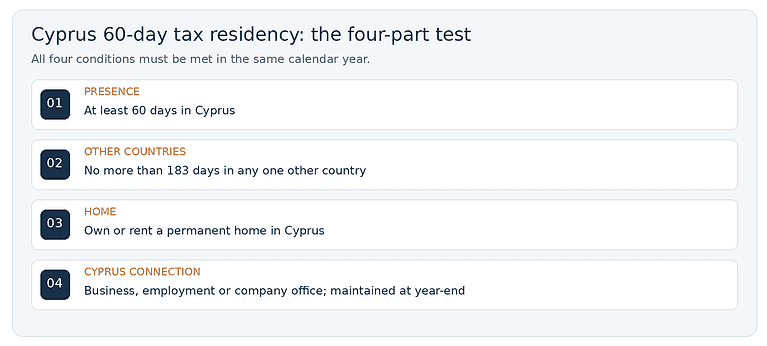
Cyprus has two routes to personal tax residence: spending more than 183 days in the country, or meeting the 60-day test. The shorter route requires all of the following during the calendar year:
Spend at least 60 days in Cyprus during the calendar year.
Spend no more than 183 days in any other single country.
Keep a permanent home in Cyprus, owned or rented.
Carry on a business in Cyprus, work in Cyprus or hold an office in a Cyprus tax-resident company, with the required connection maintained at year-end.
Why nomads value the flexibility
Take a consultant who visits clients in Europe, spends part of the year in Asia and returns to Cyprus between trips. Sixty days in Cyprus may be enough for tax residence if the consultant also keeps a home there and meets the business or employment condition. There is no need to stay for six consecutive months.
Renting a flat for two months, however, is not enough by itself. The consultant must also have the required work, business or company-office connection to Cyprus. Someone employed only by an overseas company should check that point before relying on the 60-day rule.
2. Non-Dom Status: No Cyprus Tax on Dividends and Most Interest
For business owners, dividends are often more important than salary. A Cyprus tax resident with Non-Dom status pays no Cyprus personal income tax or Special Defence Contribution on dividends and most passive interest. That applies to income from companies abroad as well as from Cyprus companies.
Non-Dom status depends on Cyprus tax residence and domicile. Under the 17-out-of-20-year rule, someone who has been Cyprus tax resident for at least 17 of the preceding 20 years is treated as domiciled in Cyprus for this tax. A newcomer with no Cyprus domicile history can often use the exemption for many years, provided the other domicile rules are met.
An example: €150,000 in dividends
Annual dividends
€150,000
Cyprus personal income tax
€0
Special Defence Contribution
€0
GHS health insurance contribution (2.65%)
€3,975 (capped at €4,770 per person per year)
Total Cyprus personal charges
€3,975
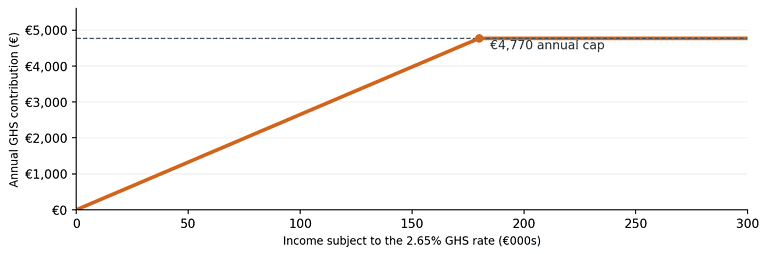
Figure 2. GHS health insurance contributions at 2.65%, capped at €4,770 annually at that rate.
The calculation below assumes €150,000 of dividends, no other income affecting the GHS calculation, and no foreign withholding tax. It shows the Cyprus personal charges only.
GHS (GeSY) is Cyprus’s public health insurance system. The contribution on dividends and certain other income is 2.65%, with a cap of €4,770 a year at that rate. People registered with GHS can use participating family doctors, specialists, diagnostic services and hospitals. Many services have small co-payments rather than full private fees.
There is a limit to what the Cyprus exemption achieves. A dividend may still face withholding tax in the country where it originates. US citizens must also report worldwide income to the IRS, even after moving to Cyprus.
3. Capital Gains on Shares: An Advantage for Founders
Selling a business can produce a much larger payment than years of dividends. Cyprus does not charge personal income tax on gains from selling ordinary shares or other securities. The company whose shares are sold can be based in Cyprus or overseas.
For example, a founder selling shares in a foreign software company may have no Cyprus tax on the gain. Shares tied to immovable property in Cyprus need closer attention: some disposals fall within Cyprus capital gains tax.
The transaction itself matters. Selling shares is not the same as having the company sell its assets. Before agreeing to a sale, the founder should check the structure and whether another country can tax the proceeds.
4. The 50% Employment Tax Exemption
A professional moving to Cyprus for work may be able to exclude 50% of employment income from Cyprus income tax for up to 17 years. The exemption is aimed at people taking up their first employment in Cyprus after a long period living abroad.
Annual employment remuneration must exceed €55,000.
The individual must not have been a Cyprus tax resident during the 15 consecutive years before starting employment.
The work must be carried out in Cyprus and meet the statutory rules for first employment there.
The exemption is for salary, not dividends or freelance profits. An executive earning €120,000 a year who meets the rules can exclude €60,000 from Cyprus income tax. The other €60,000 is assessed under the normal rates, after any deductions that apply.
A founder employed by their own company may be able to combine the salary exemption with Non-Dom treatment on dividends. The employment must be real, and payroll and social insurance obligations still apply. Paying oneself a salary does not by itself establish entitlement to the exemption.
5. Running an International Business from Cyprus
Consultants, software developers and other service businesses can operate through a Cyprus company. The corporate income tax rate is 15% from 2026. That tax is charged on company profits before any dividend is paid to the owner.
Suppose a Cyprus consulting company earns a profit and pays corporate tax. It then distributes the remaining profit to its shareholder, who is a Cyprus tax resident with Non-Dom status. Cyprus does not charge personal income tax or Special Defence Contribution on that dividend. GHS health insurance contributions can still apply at 2.65%, capped at €4,770 a year at that rate. Registered members receive access to covered healthcare services.
Where the work happens is just as important as where the company is registered. A company managed from another country, or with staff working there, may owe tax in that country too. Founders moving an existing business should deal with those questions before changing its structure.
6. A Practical Base for People Who Travel
Cyprus also works as a place to live between trips. English is used widely in business, there are direct flights to European and Middle Eastern cities, and residents have access to local banking, professional services and healthcare.
There is a cost to keeping a permanent home in Cyprus while travelling. Rent or property expenses continue even when the home is empty. For someone who returns regularly, that may be preferable to moving between short-term rentals. It also helps meet one of the conditions of the 60-day rule.
7. Digital Nomad Visa Is Not the Same as Tax Residency
A visa gives someone permission to live in Cyprus. Tax residence is a separate question. Holding one does not automatically establish the other.
The Cyprus Digital Nomad Visa is for non-EU and non-EEA citizens working remotely for employers or clients outside Cyprus. Applicants must show net income of at least €3,500 a month after taxes and contributions. The first permit lasts one year and can be renewed for another two years. Family members may be able to join, but restrictions apply to their right to work.
EU citizens use a different residence process under EU free-movement rules. For non-EU citizens, the Digital Nomad Visa deals with immigration status; it does not replace the 60-day tax test. A remote worker still needs to check the Cyprus business, employment or company-office requirement.
8. Leaving the Previous Tax Residence Behind
Getting Cyprus tax residence is only half the job. The country someone leaves may continue to treat that person as tax resident, especially if they keep a home or close family ties there.
A person leaving the UK must check the Statutory Residence Test. Someone moving from Germany must consider whether a home remains available there. The Cyprus rules do not override either country’s residence rules.
If both countries claim residence, a tax treaty may settle the issue for treaty purposes. Homes, family connections and the centre of personal and economic interests can all matter. These questions are best addressed before the move, not after two tax authorities have issued assessments.
9. Who Benefits Most?
The numbers will not work for everyone. A remote freelancer on a modest income may spend more on maintaining a Cyprus home and meeting the residence requirements than they save in tax.
For an owner drawing large dividends, the position can be very different. A founder expecting to sell shares may benefit from the exemption on securities gains. Someone moving for a well-paid job may find the 50% employment exemption more valuable than Non-Dom status.
The common requirement is a real connection to Cyprus: a home and the work, business or company role required by the residence rules. A tax plan built around where someone actually lives and works is easier to maintain than one based only on counting days.








No Comment! Be the first one.