Most advice for beginners points in the wrong direction. It pushes you toward coding bootcamps, oversized portfolios, or a stack of certificates before you earn your first dollar online. In practice, many legitimate work from home jobs with no experience start with something simpler. Clear writing, basic tech comfort, reliability, and the ability to follow a process.
The key question is not which job titles sound entry-level. It is which platforms and companies give beginners a fair starting point. That difference saves time. Some remote roles look accessible in a job ad, then expect prior customer support experience, sales experience, or a polished portfolio once you apply.
This guide reviews the starting points that are more realistic. I’m focusing on platforms and companies the way you would review a product. How flexible is the work. How does the pay structure work. How friendly is the setup for someone starting from zero. If you also want a broader path into entry-level online work, this guide on finding a part-time virtual assistant job gives useful context on how beginner-friendly remote roles tend to work.
If you’re trying to break into work from home jobs with no experience, start with systems built around trainable, repeatable tasks. That is usually the fastest way to get credible remote experience, even if the first role is not glamorous. For a wider strategy before you apply, this guide on how to get a job with no experience is worth reading.
1. ModSquad

If you want remote jobs with no experience that don’t revolve around back-to-back phone calls, ModSquad is one of the better starting points. It’s especially strong for people who already spend time in online communities, gaming spaces, support forums, or social platforms and understand how digital conversations work.
The work usually sits somewhere between customer support, trust and safety, and community operations. That matters because those are real career paths later. You’re not just taking “any remote job.” You’re building proof that you can handle customer issues, protect brand standards, and communicate in writing under pressure.
What ModSquad is good at
A beginner usually fits best here if they prefer text-based work and can stay calm when conversations get messy.
- Written communication first: Many projects lean into chat, moderation, ticketing, or social responses instead of heavy phone support.
- Flexible project mix: You may find community moderation, email support, trust and safety work, or brand-side engagement tasks.
- Remote-native setup: The platform is built around distributed work, which makes it more relevant than companies that merely “allow remote.”
Practical rule: If you hate live calls but you’re strong in writing, moderation and community support are often a better first move than generic call center work.
The trade-off is inconsistency. Hours can depend on project demand, and not every opening is equally beginner-friendly. That’s common with contractor platforms. They’re good launchpads, but not always stable enough to be your only income source on day one.
If you’re also considering admin-heavy entry level jobs from home, pair this with a guide to finding a part-time virtual assistant job. The overlap in skills is bigger than often assumed: inbox management, tone control, fast replies, and good judgment.
2. TELUS International AI Community
For people asking, “what jobs can I do from home with no experience if I want something task-based, not customer-facing,” TELUS International AI Community is one of the cleaner answers. The contributor model usually centers on rating, labeling, data collection, and evaluation work that depends more on careful reading than on prior job history.
This category has grown because remote data and evaluation work now shows up across major job boards. One market snapshot notes that data analysis and AI evaluation roles represent 25% of no-experience remote listings, with examples including trainee roles focused on reviewing and ranking AI reasoning outputs in this Indeed-backed roundup.
Where it works for beginners
TELUS tends to suit people who are patient with guidelines and okay with repetitive quality-based work.
- Low experience barrier: You’re usually being tested on accuracy, language ability, and rule-following.
- Useful for side income: This can fit around studies, part-time freelancing, or travel days when your schedule is uneven.
- Relevant future skills: Search quality and AI evaluation experience can help you move toward other remote operations work later.
Some of the best stay at home jobs with no experience aren’t glamorous. They’re structured, repetitive, and good at teaching focus.
The downside is availability. Project flow can change by language, region, and timing. That makes this better as a flexible income stream than a guaranteed full-time base. If you need predictability for rent, visas, or flights, treat it as one layer of your income stack.
If you want similar beginner-friendly paths beyond AI rating, Remote Tribe’s list of digital nomad jobs you can start with no skills gives a wider view.
3. Transcom
If you want structure, Transcom is a stronger option than the gig-style platforms. This is the kind of company to look at when you want working from home jobs entry level with formal onboarding, clearer expectations, and an actual ladder beyond your first role.
A lot of beginners underestimate how useful that structure is. Contractor flexibility sounds attractive until you realize you also need stable shifts, coaching, and someone to tell you what “good performance” looks like. Transcom is better for that kind of start.
Best fit for people who want training
Transcom is usually a better match if you want a real team environment and can handle metrics.
- Employee-style setup: More suitable for people who want a conventional job instead of piecing together freelance tasks.
- Training included: That matters when you’re starting from zero and need process, scripts, and systems.
- Career path: Customer support often leads to QA, team lead, workforce support, or specialized product support.
The catch is that stable companies also enforce stable-company rules. Schedule adherence matters. Performance metrics matter. Some roles are tied to specific states or locations. If your ideal remote life means hopping countries every few weeks, this can feel restrictive.
Still, for legitimate work at home jobs with no experience, a company like this often gives beginners what marketplaces can’t: consistency. If your main goal is to get hired fast and build remote credibility, that matters more than maximum freedom at the start.
4. Working Solutions
Working Solutions sits in the middle ground between full employee structure and fully open gig work. It’s a legitimate long-running option for customer care, reservations, and support projects, and it’s especially useful if you want some scheduling control without being completely on your own.
I usually recommend this kind of platform to people who want work from home with no experience needed, but who are realistic about output-based pay. That point matters. Flexibility sounds great until you understand how you’re paid.
The trade-off most beginners miss
Working Solutions lets you choose programs, but your earnings depend on productive time, not just being available at your desk.
- Flexible program selection: You can target projects that fit your availability and comfort level.
- Client-specific training: Good for learning systems without needing previous call center experience.
- Better than random gig apps: The company has a clear application path, defined programs, and visible operating standards.
Flexibility isn’t free. On contractor support platforms, the cost is usually variable workload, unpaid idle time, or both.
That doesn’t make it a bad option. It makes it a platform that rewards people who understand utilization. If you’re efficient, responsive, and can work peak demand windows, it can be a solid bridge into remote customer experience work. If you need guaranteed hourly steadiness, you may prefer a W-2 employer instead.
For beginners, this is still one of the more credible portals in the stay at home jobs with no experience category because it avoids the sketchy “pay to start” trap that so many fake listings use.
5. Rev
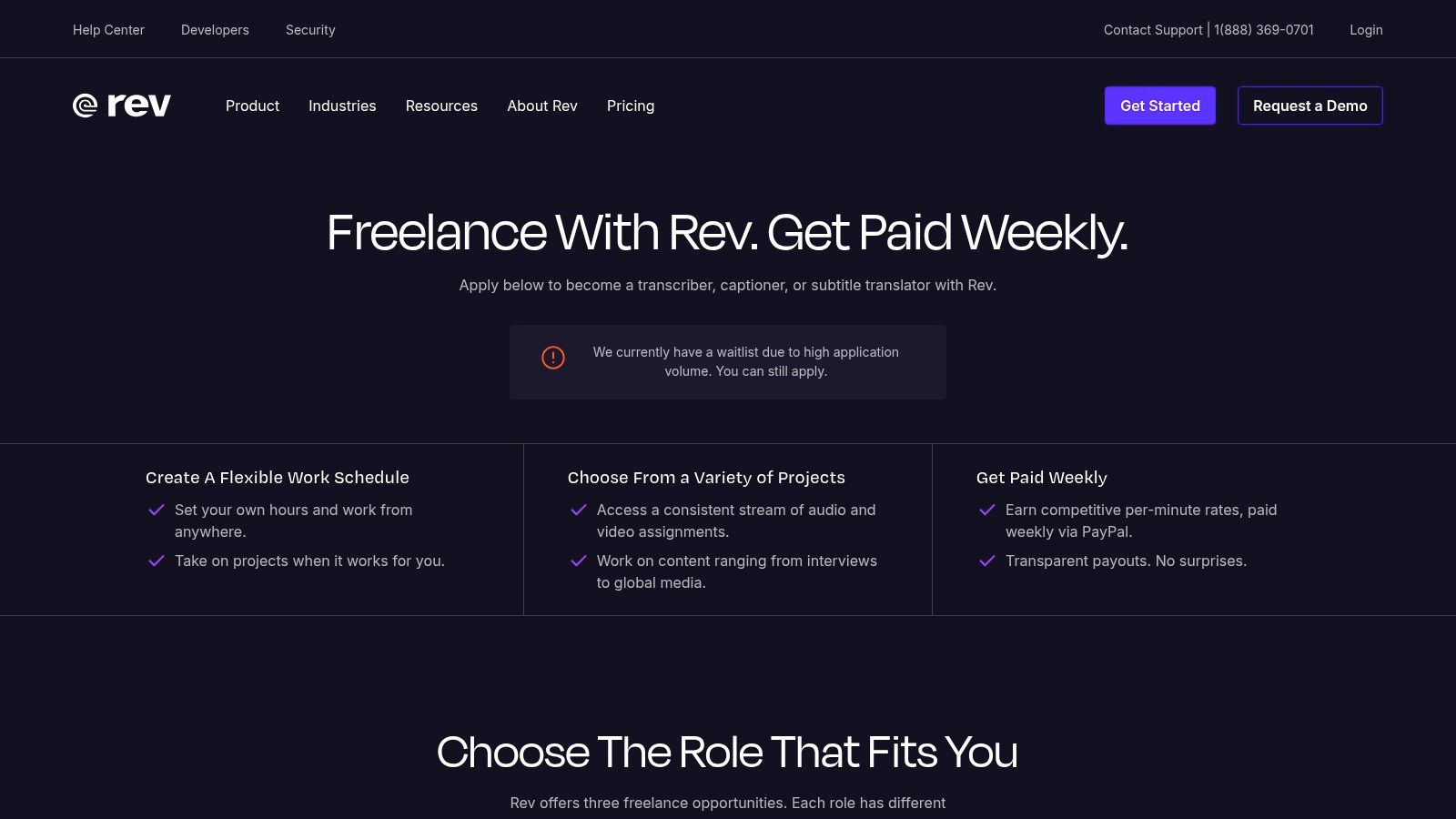
If your strengths are listening, grammar, and focus, Rev is one of the simplest entry points. You don’t need formal experience in transcription or captioning to get started. You do need accuracy, decent typing speed, and the patience to work through messy audio.
This is one of those entry level jobs from home that looks easy from the outside and becomes harder once you start. Audio quality varies. Speakers interrupt each other. Accents and background noise can slow you down. That’s why Rev works best for detail-oriented people, not for anyone chasing “easy money.”
Why Rev still works
The appeal is straightforward. You apply, complete the required assessment, and if accepted, choose work from a marketplace model rather than waiting for a manager to assign every task.
- Very low barrier to entry: No traditional resume-heavy path.
- Self-scheduled work: Helpful if you’re traveling, studying, or building another income stream.
- Transferable skills: Transcription sharpens formatting, quality control, and written accuracy.
Rev also fits people exploring broader non-technical remote jobs for digital nomads. It won’t suit everyone long term, but it can be a clean way to prove remote work discipline.
The biggest drawback is effective pay. Your real hourly outcome depends on your speed, the file difficulty, and how clean the audio is. That’s normal in freelance transcription. If you’re slow, you’ll feel it immediately. If you’re fast and careful, it can become a decent stepping-stone.
6. Cambly
Cambly is one of the most accessible remote platforms for native-level English speakers who are comfortable on camera. You’re not stepping into a formal teaching job as much as conversation-based tutoring, which makes it one of the easier work from home jobs with no experience for people who are naturally talkative and patient.
The model is simple: short video sessions with learners who want speaking practice. Minimal prep. No big lesson plans. That simplicity is the draw.
One cited benchmark in the plan notes commonly reports Cambly adult chat rates around $10.20 per hour, which is modest by remote-work standards. That means this platform is better as a starter income source or travel-supporting side stream than as a premium career move.
Who should choose Cambly
Cambly tends to work best for a specific personality type.
- Comfortable live on video: You need presence, warmth, and clear speech.
- Low-prep work preference: Good if you don’t want the admin load of full tutoring platforms.
- Cross-cultural communication: Useful if you eventually want client-facing freelance work.
If you’re nervous about remote work because you’ve never dealt with clients before, conversation tutoring is a gentle way to build confidence.
What doesn’t work is expecting high earnings with no ramp. Student demand can fluctuate, and you’re still trading time for money. But as legitimate work at home jobs with no experience go, Cambly is one of the cleaner, more understandable options.
If this route appeals to you, browse these online tutoring jobs and practical tips before you apply.
7. No Code Academy No Code 101 Course
If you only focus on job boards, you’ll miss the bigger play. Some of the best remote jobs with no experience come from becoming useful fast, not from waiting for a company to validate you. That’s where No Code 101 from No Code Academy stands out.
This isn’t a job portal. It’s a launchpad for people who want to create their own remote value by building simple websites, automations, landing pages, and lightweight products without learning traditional programming first. For beginners who feel locked out of the market, that matters. You can move from “I have no experience” to “I can build this for a client” much faster than one might expect.
Why this is the smartest long-term option on the list
Job platforms help you earn. No-code skills help you compound. That’s the difference.
A lot of remote beginners start with support, moderation, or task work, then hit a ceiling. The work is real, but it’s still someone else’s system, someone else’s schedule, and someone else’s pay structure. No-code tools can shift you toward project-based income, freelance retainers, product experiments, and portfolio-led applications.
That’s especially relevant now because beginner-accessible data and research work has expanded across remote job markets. For example, FlexJobs’ remote market research listings show a large pool of remote market research roles, and the same verified market snapshot notes many are accessible to beginners through data collection, survey design, and participant recruitment tasks. Those are exactly the kinds of workflows where lightweight automation, dashboards, forms, and internal tools become useful.
What I like and what I’d verify first
Here’s the honest review.
- Strong upside for nomads: You can learn skills that travel well and don’t depend on one employer or one timezone.
- Practical output focus: Building an MVP, client asset, or automation is more useful than abstract theory.
- Good bridge skill: No-code sits between operations, marketing, research, and freelance services.
There are also limits.
- Public detail is thin: The page doesn’t spell out every syllabus detail, pricing point, or instructor breakdown, so you may need to ask questions before buying.
- Tools still have ceilings: No-code won’t replace custom development for every use case.
- Some workflows need paid apps: Advanced integrations can introduce software costs.
For people serious about location independence, this is the most strategic item here. It’s not just about finding stay at home jobs with no experience. It’s about reducing how long you stay a beginner.
If you want alternatives before committing, compare it with these best no-code courses for beginners.
Remote job portals worth checking alongside these platforms
Don’t rely on one site. Mix specialist platforms with broader aggregators.
- Remote Tribe Job Board: Good for remote roles curated for location-independent workers.
- Working Nomads: Useful for scanning worldwide remote openings, including data and statistics-related roles mentioned in the verified market overview.
- FlexJobs: Especially relevant for beginner-friendly research and remote support categories.
- Indeed: Good for wide coverage, especially when you search carefully by entry-level and remote filters.
- ZipRecruiter: Useful for scale, including reported high-volume no-experience remote data analyst searches in the verified data.
- NoDesk: Helpful for remote-first roles across startups and digital companies.
- Remotive: Worth checking for distributed roles and startup-friendly hiring.
- Jooble: A broad aggregator that can surface unusual beginner openings.
7 Remote No-Experience Opportunities Comparison
| Item | Implementation complexity 🔄 | Resource requirements ⚡ | Expected outcomes 📊 | Ideal use cases 💡 | Key advantages ⭐ |
|---|---|---|---|---|---|
| ModSquad | Low 🔄, project‑level onboarding, role‑specific tasks | Minimal ⚡, laptop, internet, strong writing/judgment | Entry‑level community/trust & safety experience; variable hours/pay 📊 | Part‑time chat moderation, community ops, T&S first roles 💡 | Good stepping stone into community ops; text‑focused projects ⭐ |
| TELUS International AI Community | Low 🔄, guideline‑driven tasks after assessments | Minimal ⚡, device, connection; language skills helpful | Short‑hours income; hands‑on AI/data labeling experience 📊 | Microtask data labeling, search/ads quality, bilingual contributors 💡 | Low barrier; builds AI/LLM data skills ⭐ |
| Transcom | Moderate 🔄, formal onboarding and scheduled training | Higher ⚡, quiet workspace, reliable tech; equipment sometimes provided | Stable W‑2 employment, predictable shifts, career progression 📊 | Candidates seeking structured remote CSR/tech support roles 💡 | Corporate credibility, formal training and advancement paths ⭐ |
| Working Solutions | Low‑Moderate 🔄, contractor onboarding and client training | Moderate ⚡, meet client tech specs; home office requirements | Flexible CX experience; pay per productive minute (variable) 📊 | Remote customer care, sales, reservations with schedule control 💡 | Transparent pay model, long‑standing brand trust ⭐ |
| Rev | Low 🔄, short skills test; self‑selected files | Minimal ⚡, computer, quality audio, fast typing | Flexible freelance earnings; transcription/captioning experience 📊 | Freelance transcription, captioning, subtitling work 💡 | Very low barrier to entry; weekly payouts ⭐ |
| Cambly | Very Low 🔄, simple application and demo | Minimal ⚡, webcam, stable internet, native/near‑native English | Consistent but modest hourly pay; conversational tutoring experience 📊 | Casual video English conversation tutoring, flexible hours 💡 | Easiest legitimate entry to remote tutoring; low prep ⭐ |
| No Code Academy, No Code 101 Course | Low‑Moderate 🔄, self‑paced, project‑focused learning | Low ⚡, laptop, internet; may need paid no‑code tools | Ability to build MVPs, automations and client‑facing tools 📊 | Non‑technical founders, freelancers launching MVPs and services 💡 | Fast, practical path to productize ideas without developers ⭐ |
Your Remote Career Starts Now
Remote work without experience usually starts with platform choice, not talent. Pick a beginner-friendly entry point and the first few months feel manageable. Pick a poor fit and even a legitimate job can feel like proof that remote work is unstable, underpaid, or impossible to break into.
That is why this list matters less as a list of job titles and more as a shortlist of launchpads. ModSquad suits people who can handle community guidelines and irregular workflows. TELUS International AI Community is a better fit for independent workers who want task-based work and can stay consistent without much hand-holding. Transcom works better for readers who want formal training, fixed expectations, and a clearer path into customer support. Working Solutions gives you more schedule control, but contractor pay models need a hard look before you commit. Rev and Cambly are often easier to start, though both come with lower ceilings unless you use them as stepping stones. No Code Academy points in a different direction entirely. It helps beginners build a sellable skill instead of applying for another entry-level queue.
The bigger opportunity is real. Earlier in this article, I mentioned hiring data that shows how wide the remote entry-level market has become. But volume is not the same as fit. Plenty of "no experience" listings still hide awkward schedules, unpaid onboarding, narrow location rules, or pay structures that only look decent on paper.
Check the operating conditions before you apply. Time zone requirements, training quality, contract type, and whether the work is asynchronous or tied to fixed shifts often shape your day more than the title does. That is especially true if your long-term goal is travel-friendly work rather than just any job you can do from home.
Start narrower than you think you need to.
If you are asking what jobs can I do from home with no experience, choose one lane and build proof fast. Moderation, support, AI rating, transcription, conversational tutoring, or basic no-code services are all reasonable starting points. The first win is not glamorous. It is a completed shift, a good quality score, a client rating, or a small portfolio sample you can show the next employer.
A clean profile and reliable communication beat vague enthusiasm every time. If you need help with that piece, read this practical guide on how to write a CV with no experience that gets you hired.
Remote careers rarely begin with a perfect role. They begin with one credible platform, one application you can finish well, and one piece of proof that says you can be trusted online.
If you’re building toward a location-independent life, Remote Tribe is worth keeping in your regular rotation. Beyond job leads, it’s useful for the practical side of remote work too: visas, destinations, coliving, work-friendly cafés, travel products, and the systems that make remote life sustainable once you get hired.