

Meteorology for Digital Nomads: How to Use Weather Data to Travel Smarter
For most people, weather is something they simply accept. If it’s raining, they grab an umbrella. If it’s snowing, they put on a heavier coat. Their work, home, and daily routines stay largely the same regardless of the forecast.
Digital nomads have a unique advantage. We can choose where we live and work throughout the year. Yet surprisingly, many nomads still plan their travels around visa rules, accommodation prices, or social media trends while paying little attention to weather patterns.
After more than a decade of living abroad and traveling extensively, I’ve learned that weather can have a bigger impact on quality of life than almost any other factor. A destination that looks perfect on Instagram can quickly become frustrating if you’re dealing with daily rain, oppressive humidity, wildfire smoke, or temperatures that make it difficult to leave your apartment.
This is where a basic understanding of meteorology becomes useful. You don’t need to become a weather expert, but learning how climate systems, seasons, and local weather patterns work can help you make better decisions about where to go and when.
In this guide, I’ll share practical meteorology tips for digital nomads, explain the concept of weather arbitrage, and show how experienced remote workers build travel plans around the world’s best seasons.
What Is Meteorology and Why Should Digital Nomads Care?
Meteorology is the study of weather and atmospheric conditions. While that might sound like something reserved for scientists and television weather presenters, understanding a few basic concepts can significantly improve your travel planning.
Many nomads make the mistake of checking only the average temperature of a destination. Seeing 28°C and sunshine sounds great on paper. However, temperature alone rarely tells the full story. Humidity, rainfall, wind patterns, daylight hours, air quality, and seasonal weather events often have a much bigger impact on your day-to-day experience.
I’ve seen countless travelers arrive in destinations during the wrong season because they only looked at temperatures. Bali can feel very different during the wet season than during the dry season. Bangkok’s famous heat becomes much harder to tolerate when combined with high humidity. Southern Europe can be wonderful in spring and autumn but uncomfortably hot during parts of the summer.
For remote workers, weather affects more than sightseeing. It influences productivity, sleep quality, exercise habits, mental health, and even networking opportunities. If you’re spending one to three months somewhere rather than a week-long vacation, weather becomes an important lifestyle factor rather than a minor inconvenience.
The good news is that today’s digital nomads have access to far better weather data than ever before. Websites such as Weather Spark, Windy, Meteoblue, and AccuWeather make it possible to evaluate destinations months before you arrive.
Table of Contents
The Rise of Weather Arbitrage
One concept that has become increasingly popular among experienced digital nomads is weather arbitrage.
Traditionally, arbitrage refers to taking advantage of differences between markets. Digital nomads are already familiar with cost-of-living arbitrage, where earning income from a higher-income country allows you to enjoy a comfortable lifestyle in a more affordable destination.
Weather arbitrage applies the same principle to climate. Instead of staying in one place year-round, you move between destinations to consistently enjoy the best possible weather. The goal is to spend more time outdoors, remain active, and avoid extreme conditions that reduce your overall quality of life.
Many nomads do this without even realizing it. They spend winter in Southeast Asia, spring in Japan, summer in Europe, and autumn in destinations like Madeira or the Canary Islands. Over time, these seasonal moves create a lifestyle where you’re constantly experiencing favorable conditions rather than enduring long periods of uncomfortable weather.
The Reddit digital nomad community recently discussed their ideal weather-dodging destinations, and many responses followed exactly this pattern. Rather than searching for a single perfect location, experienced travelers were building annual routes designed around seasonal weather advantages.
Perhaps the biggest benefit of weather arbitrage is that it encourages long-term thinking. Instead of asking, “Where should I go next month?” you start asking, “Where should I be throughout the year?” That shift alone often leads to much better travel decisions.
Meteorology Tip #1: Learn a Destination’s Rainy Season Before Booking
One of the most common mistakes I see among newer digital nomads is focusing almost entirely on temperature. They look up a destination, see that it’s 28°C year-round, and assume they’ve found paradise.
Unfortunately, weather is rarely that simple. A destination with warm temperatures can feel completely different depending on rainfall patterns. A month with occasional afternoon showers is one thing. A month with daily rain, overcast skies, and flooding is something else entirely.
This is particularly important in tropical destinations. Places like Bali, Phuket, Manila, and Ho Chi Minh City can be fantastic locations for remote work, but the experience varies dramatically between the dry and wet seasons. During heavy rainy periods, outdoor activities become limited, transportation can become less reliable, and even simple tasks like finding a comfortable café to work from can become more challenging.
Before booking accommodation, I recommend looking beyond the average temperature and checking three key metrics: monthly rainfall totals, average number of rainy days, and humidity levels. These numbers often tell a more accurate story about what daily life will actually feel like.
For example, two destinations might both average 30°C. One could offer sunny days with low humidity and occasional showers. The other could experience daily downpours and humidity levels above 85 percent. On paper they look similar. In reality, they’re completely different experiences.
A useful habit is checking historical climate data several months before your intended arrival date. Sites like Weather Spark provide excellent visualizations that show rainfall trends throughout the year, making it much easier to identify the best times to visit a destination.
Meteorology Tip #2: Understand Shoulder Seasons
If there’s one travel strategy I’ve used repeatedly over the years, it’s targeting shoulder seasons.
The shoulder season is the period between a destination’s peak season and low season. It’s often when weather conditions remain highly favorable while prices, crowds, and accommodation shortages begin to decrease.
Many digital nomads automatically follow the crowds and arrive during peak season. While there’s nothing wrong with that approach, it often means paying significantly more for apartments, coworking memberships, flights, and daily expenses.
In many cases, the weather difference between peak season and shoulder season is surprisingly small. Portugal in May, Japan in October, and Thailand in November are all good examples. Temperatures remain comfortable, tourist numbers are lower, and you’ll usually find better accommodation options.
Shoulder seasons can also improve productivity. Popular destinations often become crowded during peak months, making it harder to find quiet cafés, available coworking desks, or reasonably priced housing. Arriving slightly earlier or staying slightly later can create a far more relaxed experience.
For digital nomads who prioritize both lifestyle and budget, shoulder seasons are often the sweet spot where weather, affordability, and quality of life intersect.
Meteorology Tip #3: Pay Attention to Humidity, Not Just Temperature
Humidity is one of the most overlooked weather factors in digital nomad travel planning.
Many travelers imagine that 30°C feels the same everywhere. In reality, humidity can dramatically change how comfortable a destination feels. A dry 30°C day in Portugal is very different from a humid 30°C day in Bangkok or Singapore.
High humidity reduces your body’s ability to cool itself through sweating. As a result, temperatures can feel significantly hotter than the actual reading suggests. This is often referred to as the “feels like” temperature, and it can be a much better indicator of comfort than the temperature itself.
I’ve personally found that humidity affects productivity more than almost any other weather variable. When the air feels heavy and sticky, concentration becomes more difficult, outdoor exercise becomes less enjoyable, and sleep quality often declines.
This doesn’t mean humid destinations should be avoided. Many of the world’s best digital nomad hubs are located in tropical climates. The key is understanding what you’re signing up for and planning accordingly.
When researching a destination, spend a few minutes reviewing average humidity levels alongside temperature data. You may discover that a city with slightly higher temperatures but lower humidity actually provides a much more comfortable working environment.
Have you heard about flag theory?
Meteorology Tip #4: Track Seasonal Hazards Before They Affect Your Plans
Weather isn’t just about sunshine, rain, and temperature. Every region has seasonal patterns that can impact travel, work, and daily life.
One of the advantages of understanding basic meteorology is recognizing these patterns before they become a problem. Experienced nomads often avoid destinations not because the weather is bad, but because a predictable seasonal event is approaching.
Northern Thailand provides a good example. Chiang Mai remains one of the world’s most popular digital nomad destinations, but many long-term travelers leave before burning season arrives. Air quality can deteriorate significantly, affecting both health and outdoor activities.
Similar examples exist elsewhere. The Caribbean faces hurricane season, parts of Southeast Asia experience monsoons, southern Europe increasingly deals with summer heatwaves, and portions of North America regularly face wildfire smoke during certain months.
These events are rarely surprises. In most cases, they occur during predictable periods every year. Spending a few minutes researching seasonal weather risks before booking accommodation can save considerable time, money, and frustration later.
The goal isn’t to avoid every destination with seasonal challenges. It’s simple to understand the risks and decide whether they align with your travel priorities.
Meteorology Tip #5: Build a Digital Nomad by Season Strategy
The most experienced digital nomads I know rarely choose destinations in isolation. Instead, they think in terms of seasons.
Rather than asking where to go next, they plan where they want to be throughout the entire year. This approach transforms travel from a series of spontaneous decisions into a deliberate strategy designed around climate, lifestyle, and productivity.
Winter often pushes nomads toward Southeast Asia. Countries such as Thailand, Vietnam, Malaysia, and the Philippines offer warm temperatures and established remote work communities during months when much of Europe and North America experience colder weather.
Spring opens up destinations such as Japan, Turkey, Morocco, and Georgia. Temperatures become comfortable, outdoor activities are enjoyable, and tourist crowds are generally smaller than during peak summer months.
Summer naturally shifts attention toward Europe. Portugal, Spain, Estonia, Poland, and other European destinations offer long daylight hours, vibrant social scenes, and ideal conditions for exploring cities and nature alike.
As autumn arrives, many nomads move toward destinations with mild climates such as Madeira, the Canary Islands, southern Portugal, and parts of California. These regions often deliver excellent weather long after northern destinations begin cooling down.
A digital nomad by season strategy doesn’t need to be rigid. The objective isn’t to create a perfect itinerary years in advance. Instead, it’s to understand global weather patterns well enough to consistently place yourself in favorable conditions throughout the year.
For many remote workers, this is where weather arbitrage becomes most powerful. Rather than enduring uncomfortable weather for months at a time, you leverage location independence to enjoy the best season each destination has to offer.
How to Create Your Own Weather Calendar (Like Experienced Digital Nomads Do)
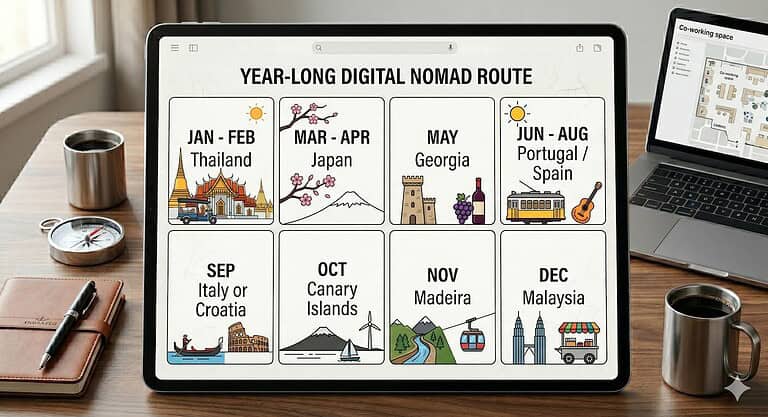
Once you start thinking in terms of meteorology for digital nomads, something changes. You stop asking “Where is nice right now?” and start building a structured view of the entire year.
In practice, many experienced nomads quietly maintain a personal weather calendar. It’s not complicated, but it gives you a huge advantage when planning long-term travel. Instead of reacting to seasons, you start anticipating them.
The idea is simple: map out where you want to be each month based on climate patterns, not just prices or visas. Reddit discussions around digital nomad weather strategies often show the same pattern—people rotating between regions to consistently stay in “good weather zones” rather than settling in one fixed location.
Here’s how to build your own version.
Step 1: Define Your “Comfort Climate”
Before choosing destinations, you need to understand your own tolerances.
Some nomads are happiest in warm, humid climates year-round. Others struggle with anything above 28°C. Some prefer four distinct seasons, while others actively avoid winter altogether.
Start by defining:
Your ideal temperature range (e.g. 18–28°C)
Your humidity tolerance
Whether you prefer dry or green landscapes
Your aversion list (heatwaves, rain, snow, pollution)
This step is often skipped, but it matters more than people think. Without it, you end up copying someone else’s route instead of building your own.
Step 2: Break the Year Into Climate Blocks
Instead of thinking in countries, think in seasons.
A practical way to structure this is:
Winter (Dec–Feb)
Spring (Mar–May)
Summer (Jun–Aug)
Autumn (Sep–Nov)
For each block, list regions that naturally align with your comfort climate.
For example:
Winter: Southeast Asia, parts of Latin America
Spring: Japan, Turkey, Morocco
Summer: Northern & Western Europe
Autumn: Canary Islands, Portugal, California
This is where weather arbitrage becomes practical. You are essentially following optimal climate zones as they shift across the globe.
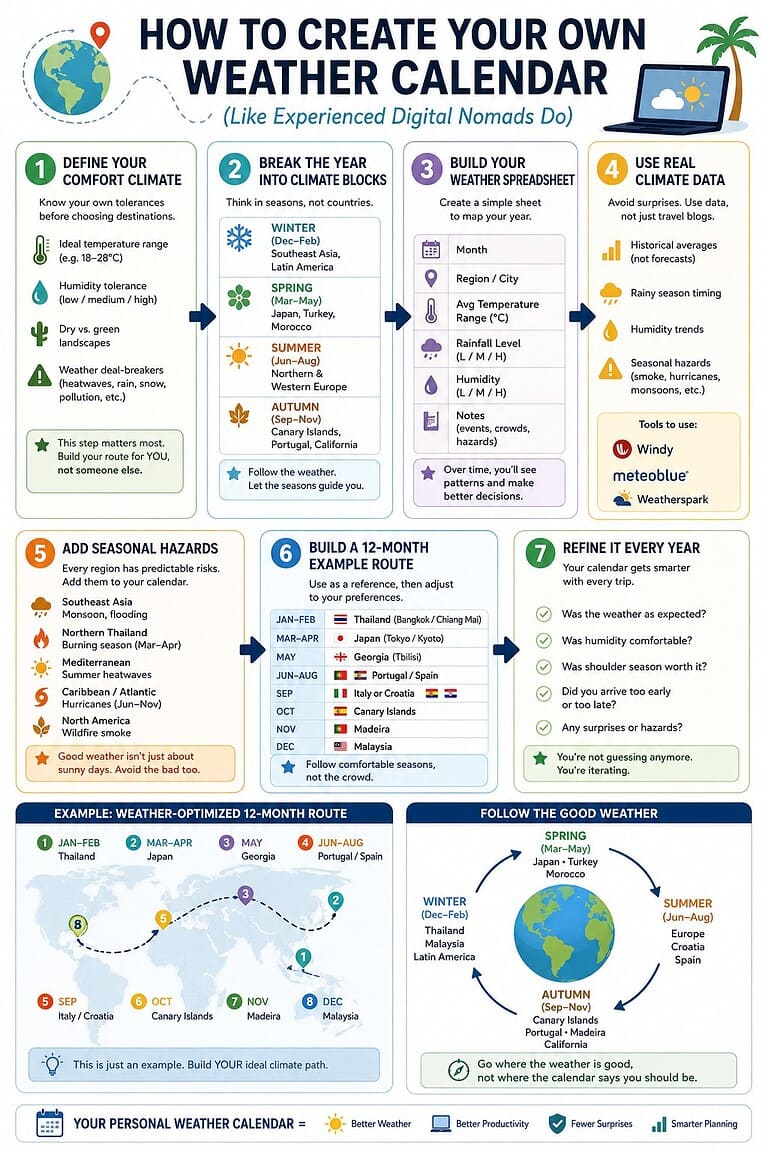
Step 3: Build a Simple Spreadsheet (Your “Weather Map”)
Most nomads who take this seriously use a basic spreadsheet. Nothing fancy.
Columns you can include:
Month
Region / City
Avg temperature range
Rainfall level (low / medium / high)
Humidity (low / high)
Notes (events, crowds, hazards)
This creates a visual “climate map” of your year.
Over time, you’ll start seeing patterns:
Where you always feel good
Where you always regret going in a certain month
Where shoulder seasons are actually better than peak season
It’s less about precision and more about pattern recognition.
Step 4: Use Real Climate Data, Not Just Travel Blogs
A lot of travel content is written from short visits, not long-term living.
For better accuracy, combine blogs with real meteorological data:
Historical averages (not forecasts)
Rainy season timing
Humidity trends
Seasonal hazards (smoke, hurricanes, monsoons)
Good tools for this include:
Windy (real-time weather systems and wind/rain patterns)
Meteoblue (long-term climate models)
Weather Spark (visual seasonal breakdowns)
The goal isn’t perfection. It’s reducing surprises.
Step 5: Add “Seasonal Hazards” to Your Calendar
This is the part most people miss, and it’s where meteorology really matters.
Each region has predictable risks:
Southeast Asia: monsoon season and flooding
Mediterranean: summer heatwaves
North America: wildfire smoke and hurricanes
Northern Thailand: burning season
Caribbean: hurricane cycles
Add these directly into your calendar.
For example:
Chiang Mai (Jan–Feb): ideal
Chiang Mai (Mar–Apr): avoid due to burning season
Lisbon (May–Jun): ideal
Lisbon (Aug): heatwave risk
This turns your calendar from “nice idea” into a decision tool.
Step 6: Build a 12-Month Example Route (Then Adjust It)
Most nomads don’t stick to a rigid plan, but having a reference route helps.
A typical weather-optimized example might look like:
Jan–Feb: Thailand (Bangkok / Chiang Mai)
Mar–Apr: Japan (Tokyo / Kyoto)
May: Georgia (Tbilisi)
Jun–Aug: Portugal / Spain
Sep: Italy or Croatia
Oct: Canary Islands
Nov: Madeira
Dec: Malaysia
The key point isn’t the exact locations. It’s the logic behind them.
You’re following comfortable seasons rather than reacting month by month.
Step 7: Refine It Every Year
Your first version will be imperfect. That’s normal.
After each trip, update your notes:
Was the weather actually as expected?
Did humidity affect productivity?
Was “shoulder season” worth it?
Did you arrive too early or too late?
Over time, your personal weather calendar becomes a very accurate system tailored to your preferences.
This is where experienced nomads quietly separate themselves from casual travelers. They aren’t guessing anymore—they’re iterating.
Final Thought
Building a weather calendar is not about controlling nature. It’s about understanding it well enough to make better decisions.
Once you start thinking this way, travel becomes less random. You stop chasing destinations and start moving through the year with intention.
That’s the real advantage of meteorology for digital nomads—and the foundation of weather arbitrage done properly.

Andrew Williams is the Founder of Remote Tribelife, an online magazine for digital nomads and remote working. Andrew has an extensive background in SEO and content marketing. His experience with digital marketing goes back to his early age in University when he founded a blog about startups and funding. He does his best writing in the coffee shops in Bali or in the condos of busy cities like Bangkok and Singapore. He is currently based in Singapore. You can connect with Andrew on his Linkedin profile and/or follow Remote Tribelife on Instagram.
Other Articles


One Comment
Comments are closed.






[…] out as the sunniest region, making it a fan favourite for remote workers looking to relocate for warmer weather. The historic country is actually ranked as one of the safest countries in the entire world, which […]