

You open another booking tab, filter for “entire place,” add WiFi, washer, kitchen, and a desk if you’re lucky, then watch the price jump. The photos look polished, the reviews are vague, and the apartment somehow still has one chair, no monitor space, and a table better suited to eating noodles than doing client work.
That’s why more remote workers are looking seriously at home swap holidays. Not as a quirky travel experiment, but as a practical way to cut accommodation costs, stay in real neighborhoods, and live somewhere that feels like a home instead of a temporary set.
For digital nomads, the appeal goes beyond saving money. A good swap can give you a proper kitchen, laundry, more space, and a more grounded routine. A bad one can wreck your workweek. The difference comes down to understanding how house swaps for holidays work, how to vet them properly, and how to avoid the legal and logistical mistakes that standard travel guides barely mention.
The End of Expensive Airbnbs for Nomads
A lot of nomads hit the same wall. You can afford the flight, you can work from anywhere, but accommodation keeps swallowing the budget. Short term rentals often charge premium prices for places that feel generic, stripped of personality, and only half set up for real life.
Home swapping offers a different model. Instead of paying nightly rates, you exchange access to your own place, or earn credits by hosting and use those credits elsewhere. The broader trend is no longer niche. The home swapping market was valued at $1.8 billion in 2025 and is projected to reach $4.6 billion by 2034 according to ABC News coverage of the home swapping market.

What makes this especially relevant for remote workers is the fit with slow travel. If you’re staying long enough to need grocery stores, a reliable chair, quiet calls, and some sense of neighborhood rhythm, a swap often beats a hotel and many short term rentals.
Practical rule: Home swap holidays work best when you want to live somewhere, not just sleep there.
That’s the key shift. A house swap vacation isn’t just about free nights. It’s about getting access to a functioning home base. You’re more likely to find a stocked kitchen, laundry, plants on the balcony, and the kind of practical details that matter after day three.
There’s also a mindset difference. People who like holiday house swaps usually want local immersion, not a polished transaction. That aligns well with the digital nomad crowd, especially anyone tired of cycling through overpriced apartments that all look the same and none feel usable for a month of work.
How Swapping Houses For Vacation Actually Works
The basic idea is simple. You make your home available, someone else makes theirs available, and the platform handles the matching, messaging, and often the trust layer.
In practice, there are two main models. If you’re thinking about swapping houses for vacation, you need to know which one fits your lifestyle.
Direct swaps
This is the classic version. You stay in my home while I stay in yours, usually at the same time. It works well if both sides want each other’s location and dates line up cleanly.
For a digital nomad, that can be great for planned seasonal moves. It’s less useful if your travel style is fluid or you don’t want your own schedule tied to someone else’s.
Points based swaps
This is the format that makes home swapping much more usable for remote workers. You host someone in your place, earn platform credits or points, then use those on a different home later. No need for a one to one match.
That flexibility matters. If you want to spend a month in Lisbon, then later do a few weeks in Mexico City, a points model is usually far easier than trying to coordinate mirrored travel dates.
The best platforms don’t just swap homes. They swap timing.
Platforms usually calculate point values based on things like location, size, beds, and amenities. That’s why a compact city apartment with a decent work setup can be very attractive, even if it isn’t “luxury.”
The money side
Accommodation isn’t paid nightly in the usual sense, but it isn’t totally free either. There’s still a platform cost. That’s the trade. You’re replacing nightly lodging fees with a membership and the effort of hosting, listing, and vetting.
The upside can be substantial. LoveHomeSwap members report average savings of $5,750 per trip, while platform memberships typically range from $120 to $220 annually, according to International Traveller’s breakdown of home swap economics.
That’s why the breakeven point is often fast. If you’re doing even one meaningful trip a year, especially to an expensive city, the math can work in your favor quickly.
For a step by step walkthrough of setup, profiles, and first exchange mechanics, this home exchange guide for beginners is worth reading before you join anything.
What works and what doesn’t
A few patterns show up fast once you start looking seriously at house swaps for holidays:
- Works well: Longer stays, flexible dates, people with a real primary residence, and travelers who value kitchens, washing machines, and neighborhood life.
- Works poorly: Last minute planning, vague communication, and anyone expecting hotel style consistency.
- Works best for nomads: Cities where rent is painful, and where having a lived-in apartment is more useful than having a polished but empty rental.
If your goal is to swap houses for vacation once a year, almost any decent platform can work. If your goal is to build a repeatable nomad accommodation strategy, flexibility and workspace vetting matter far more.
Top Home Swap Platforms Reviewed for Nomads
Most platform reviews focus on family holidays. That’s useful, but it misses what matters to remote workers. You’re not only asking whether the apartment is charming. You’re asking if you can take calls there, work for a week without back pain, and extend the stay without the whole arrangement becoming awkward.
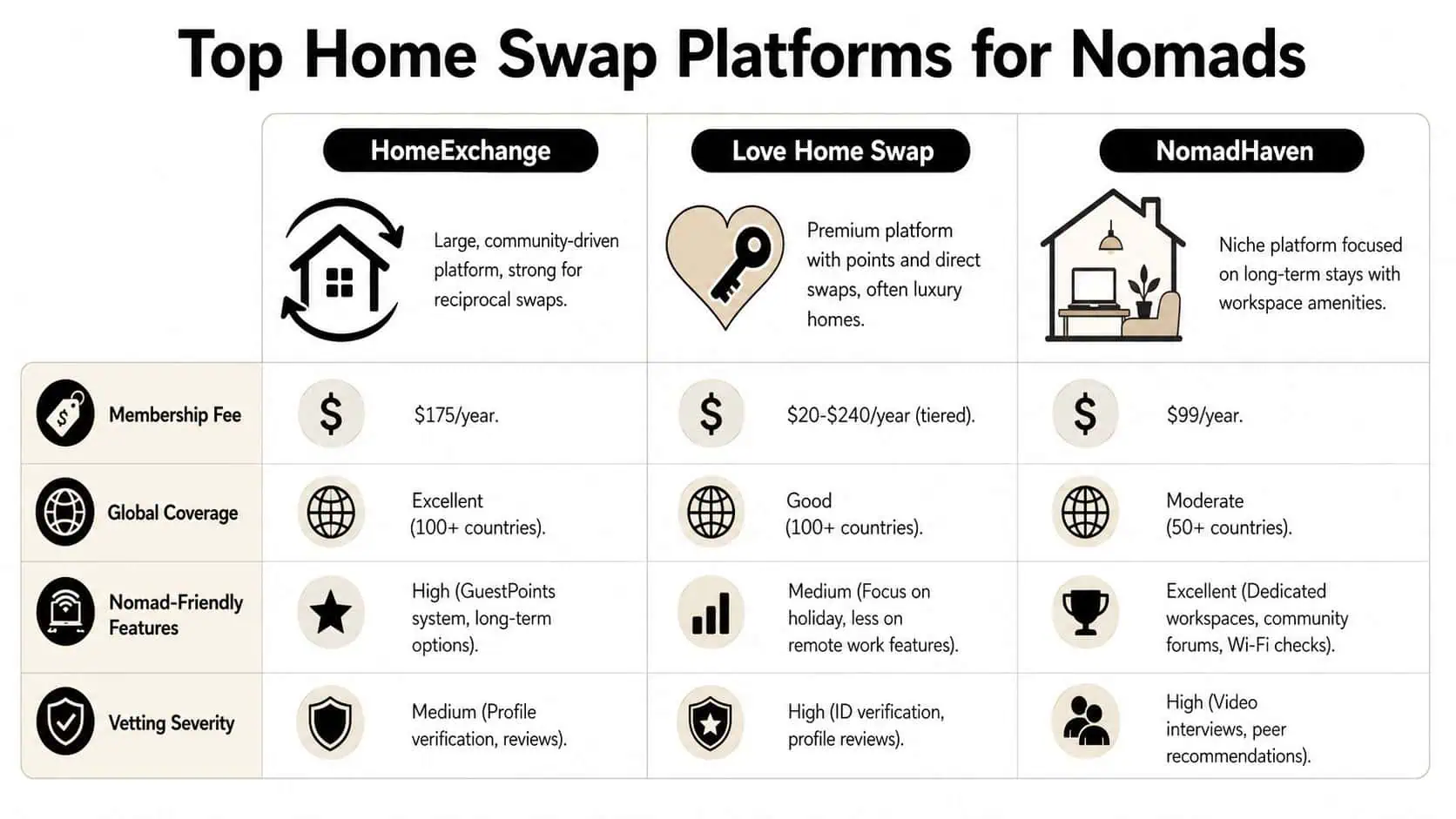
HomeExchange
HomeExchange is the heavyweight. It has broad inventory, a mature community, and a points system that makes non-simultaneous travel much more realistic.
The big advantage is choice. If you want flexibility, this is usually where you start. It’s also the easiest platform to use if your place is in a location that may not attract a direct reciprocal swap, because points reduce the need for a perfect two way match.
For nomads, the downside is that the platform is built for a broad audience, not specifically remote workers. You’ll still need to ask the work questions yourself. Desk photos, chair quality, call privacy, and internet stability often aren’t clear from the listing.
Best for: Variety, flexible timing, first time swappers
Less ideal for: People who want remote-work-specific filters built in
Love Home Swap
Love Home Swap sits a bit more toward the premium end. The listings often look polished, and the platform can be appealing if aesthetics matter to you or if you want a more curated feel.
Its biggest strength is the potential quality of the homes. Its biggest weakness for nomads is that visual quality doesn’t always equal workability. A stylish dining table is not a workstation. A beautiful rural home is not a good base if you need stable calls and easy coworking backups.
Many remote workers get seduced by photos. Don’t confuse “nice for a week off” with “good for a working month.”
Kindred
Kindred has become part of the conversation because it appeals to people who like design, community, and a more modern product feel. It tends to resonate with urban travelers and members who care about a smoother, more lifestyle-oriented experience.
For nomads, the promising part is that the community often feels aligned with people who live well in their homes. That can translate into better kitchens, better neighborhoods, and spaces that don’t feel purely set up for guests.
The limitation is practical. Depending on where and how you travel, inventory may shape your options more than branding does. If you need very specific cities or month-long windows, supply matters more than cool positioning.
Swaphouse
Swaphouse is the platform that gets the most attention from remote workers for one reason. It openly frames itself around homes that are ready for both everyday living and getting work done.
That matters. Most mainstream swap platforms talk about authenticity, budget, and local immersion. Swaphouse speaks more directly to the nomad question: can I function here Monday to Friday?
The catch is that niche focus can mean narrower inventory than the giant generalist platforms. Still, if work setup is your first filter, it deserves a close look.
A nomad scorecard
Here’s the quick comparison I’d use before committing time to a profile:
| Platform | Good for | Watch out for |
|---|---|---|
| HomeExchange | Flexible travel, points-based options, lots of listings | Work details often require manual vetting |
| Love Home Swap | Higher-end homes, polished listings | Holiday focus can outweigh work practicality |
| Kindred | Design-conscious homes, strong lifestyle fit | Availability may be more selective |
| Swaphouse | Remote work alignment, nomad-friendly positioning | Smaller ecosystem than mainstream options |
A beautiful home is nice. A home where you can work comfortably for four weeks is better.
If you want a broader platform roundup before choosing, this guide to the best home exchange websites for remote workers is a useful companion.
What I’d choose based on travel style
If you’re new to holiday house swaps, start with the platform that gives you the widest range and the easiest first win. That usually means a larger ecosystem.
If you already know your firm requirements, especially around workspace and longer stays, a niche platform can save time. The smaller search pool may be worth it if it filters out homes that were only ever meant for a casual house swap vacation.
The biggest mistake is choosing based on headline brand appeal. Choose based on where you want to go, how long you’ll stay, and how much friction you’re willing to handle during vetting.
Vetting Swaps and Guests for a Safe Experience
Trust is the whole game in home swapping. Not platform branding. Not listing photos. Trust, backed by evidence.
That matters even more for nomads because a bad swap doesn’t just ruin a holiday. It can interrupt client calls, delay deadlines, and push you into last minute paid accommodation when you thought your housing was sorted.

Vet the home like a workplace
A lot of people still approach house swaps for holidays as if they’re booking a cozy break. Remote workers can’t do that. You need to assess the property as both a living space and a functional office.
That’s especially important because work setup is often underexplained. As Swaphouse’s remote worker focus makes clear, newer platforms recognize the gap, but nomads still need to actively verify WiFi quality, workspace details, and ergonomic basics themselves.
Ask for specifics, not adjectives.
- Internet proof: Request a recent speed test screenshot and ask whether the host has experienced outages during video calls.
- Desk reality: Ask for a current photo of the desk, chair, and the natural light around that setup.
- Noise pattern: Find out what the apartment sounds like during weekday mornings, not just weekends.
- Power reliability: Ask whether the area gets cuts or building-wide outages.
- Mobile backup: Check if tethering works well in the neighborhood in case the fixed line fails.
Vet the person too
The best sign in a swap is responsive, clear, low-drama communication. People who answer questions directly usually host better too.
I like to move to a video call before confirming anything long term. It helps in two ways. You can do a casual live walk-through of the space, and you get a fast read on whether the other person feels organized and honest.
If you want to add another layer of caution, especially for a longer stay or a swap involving pets, cars, or family homes, this actionable guide to online background checks gives a sensible overview of what can be verified and where to be careful.
If a host avoids simple verification requests, assume the issue isn’t the request. It’s what the request might reveal.
Red flags that usually aren’t worth rationalizing
Some problems are manageable. Others are warnings.
- Too much vagueness: “The WiFi is usually fine” is not a real answer.
- Old photos only: If they can’t show the current setup, assume the listing is doing the heavy lifting.
- Defensiveness: A good host understands why a remote worker asks detailed questions.
- Messy logistics: Unclear check-in plans often predict other avoidable friction.
- Pressure to decide fast: Good swaps can move quickly. They shouldn’t feel rushed.
Scams exist in every accommodation category, and the patterns overlap more than people think. For extra due diligence, this breakdown of popular Airbnb scams and how to avoid them is helpful because many of the same warning signs show up in informal swap conversations too.
What good vetting looks like
Good vetting isn’t suspicious. It’s collaborative. The strongest swaps usually happen when both sides are detailed, transparent, and a little obsessive.
That includes sharing house manuals, discussing expectations around guests, being honest about quirks, and confirming exactly what “work-friendly” means. Some homes are fantastic for a long lunch and mediocre for a work sprint. Others look plain in photos and turn out to be perfect.
For home swap holidays, that distinction matters more than décor.
Navigating Insurance Legal and Visa Rules
Many otherwise smart travelers often get sloppy here. Because no money changes hands in the normal accommodation sense, people assume a swap sits outside the usual legal and administrative issues. It doesn’t.
A home swap can still affect insurance, building rules, immigration status, and tax exposure. If you’re doing one short trip a year, the risk is lower. If you’re building a mobile lifestyle around repeated or extended swaps, you need to be much sharper.
Insurance first
Start with your existing policy, whether that’s homeowners or renters insurance. Read the parts about guests, temporary occupants, liability, valuables, and property damage. Then ask your insurer directly how a home exchange is treated.
The key point is simple. Don’t assume “guest” means “covered in the way I expect.” Some policies may be fine with short occupancy by invited guests. Others may treat an organized exchange differently, especially if there’s any ambiguity around duration or responsibility.
You should also check building rules, lease terms, and local housing restrictions. Owners in apartment buildings and renters both run into trouble when they treat private agreements like they override the contract they already signed.
Put the agreement in writing
Even with the friendliest swap partner, write things down. You don’t need a dramatic legal document for every exchange, but you do need a clear record of expectations.
Include basics like:
- Dates and times: Arrival, departure, key handoff, and what happens if travel shifts.
- Access rules: Which rooms, closets, or storage spaces are off limits.
- Utilities and supplies: Who pays for what, and what level of household staples is expected.
- Cleaning standard: What “leave it as you found it” means.
- Damage process: How small breakages or bigger issues will be reported.
A written agreement doesn’t make a bad swap good. It does make misunderstandings easier to resolve.
Put ordinary expectations in writing while everyone is relaxed. It’s much harder once something has gone wrong.
Visa and tax exposure
This is the part most travel content ignores, and it matters. According to HomeExchange’s own U.S. page on home exchange considerations, repeated swaps in one country for over 90 or 183 days can create legal and tax complications, including potential tax residency issues.
That doesn’t mean every long stay triggers residency. It means you cannot treat free accommodation as invisible. Immigration officers and tax authorities usually care about where you are, how long you stay, and what ties you create. They do not care much whether you paid hotel rates.
For nomads, the danger zone is cumulative presence. You might move between swapped homes and still spend enough time in one country to raise questions. That’s why this guide to common digital nomad visa questions is worth reviewing before planning a long run of stays.
Don’t forget pets and practical border issues
Pet owners need one more layer of planning. A swap can solve accommodation, but it doesn’t solve entry rules, transport paperwork, or vaccination requirements. If your home exchange includes bringing an animal, this guide to seamless pet travel is a solid checklist before you lock anything in.
The sensible way to think about compliance
Treat a house swap vacation the same way you’d treat any other international base. Ask four questions:
- Am I allowed to stay this long on my current status?
- Could this duration affect tax residency or local registration rules?
- Does my insurance cover this arrangement?
- Do my lease, building, or local regulations allow it?
If you can’t answer those clearly, pause before confirming. Home swap holidays can be a brilliant accommodation strategy. They’re not a loophole that cancels the rest of adult admin.
Your Pre-Swap Checklist and Etiquette Guide
By this point, the appeal is obvious. So are the risks. The good news is that a strong swap usually feels smooth because the prep was solid.
Interest in home swapping has climbed sharply, with some platforms seeing a 103% spike in interest, reflecting the move away from hotels and toward more local, lived-in travel experiences, as noted earlier in the reporting from ABC News. That only makes etiquette more important. The community side of holiday house swaps works when people behave like guests in someone’s real life, not anonymous users of a booking app.
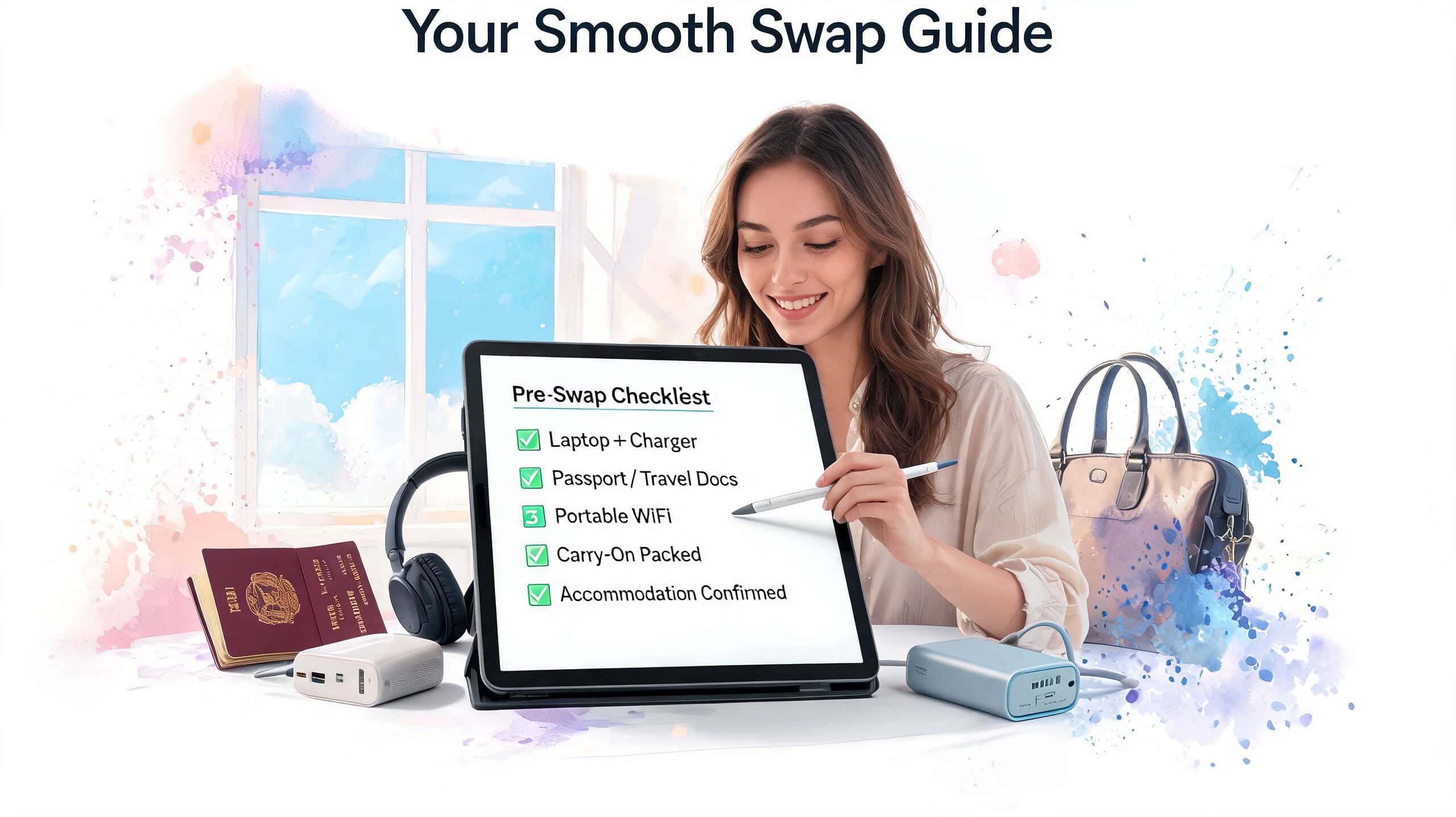
Before you go
Use a real checklist. Don’t trust memory, especially if you’re leaving for a month.
- Confirm the practicals: Recheck arrival time, keys, entry instructions, WiFi details, and a backup contact.
- Prepare your home guide: Include appliance instructions, trash routine, quirks, and favorite local spots.
- Lock away private items: Documents, spare bank cards, medication, and anything you’d rather not explain.
- Set expectations early: Clarify cleaning, guest rules, pet care if relevant, and what supplies can be used.
A fuller digital nomad travel checklist helps here, especially if your swap is part of a longer working trip rather than a simple break.
While you’re there
Good guests make the whole ecosystem work. If you want future approvals, act like someone you’d gladly host yourself.
- Use the home gently: Don’t rearrange everything unless the host says it’s fine.
- Replace what matters: If you finish staples or break something minor, sort it out without making it awkward.
- Communicate fast: If there’s a leak, power issue, or appliance problem, message early.
- Respect privacy: Closed doors, private storage, and personal papers stay untouched.
Here’s a useful visual walkthrough before your first swap:
After the swap
The final day shapes your reputation more than the first message did.
Leave the place clean, reset the basics, and write a review that’s honest and useful. Not performatively nice. Useful. Mention what future guests would want to know, especially if the home was good for remote work.
Leave the home in the condition you’d hope to walk into after a long flight and a delayed train.
For swapping houses for vacation, etiquette isn’t a soft extra. It’s infrastructure. The cleaner, clearer, and more considerate you are, the easier it becomes to get yeses on the next round.
That’s what makes home swap holidays sustainable for nomads. Not just cheaper stays, but a repeatable system built on trust, clarity, and homes that support real life.
Remote Tribe helps digital nomads make these decisions with less guesswork. If you want practical guidance on visas, accommodation, destinations, gear, and staying productive on the road, explore Remote Tribe.








No Comment! Be the first one.