If Spain has been on your digital nomad radar, 2025 might be the year to finally make the move. With the launch of its Digital Nomad Visa (DNV), officially called the International Teleworker Visa, Spain has quickly become one of the top global destinations for international remote workers.
I love my life in Spain and wanted to dig into why digital nomads and remote workers are increasingly choosing Spanish cities as their base.
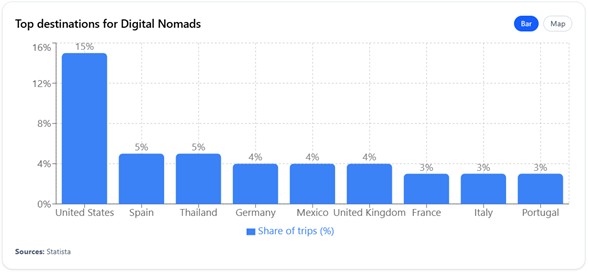
In 2025, Spain ranks #2 globally by share of digital-nomad trips (5% after the United States) and offers one of the world’s strongest digital-nomad programs. A few fundamentals might explain this:
Connectivity & speed
Household internet access: 96.8% of households are connected.
Fixed broadband coverage (mid-2024): ≥100 Mbps reaches 95.7% of households and gigabit coverage reaching 93.9%.
5G coverage (mid-2024): ~96% of the population overall and ~80% in rural areas.
Mobility & access
Air travel: Spain welcomed 309.3 million passengers in 2024 across 46 airports + 2 heliports, with 3,550 routes.
High-speed rail (AVE): ~3,974–4,000 km, it ranks #1 in Europe by network length.
Cost & quality of life
Prices: Spain’s overall consumer price level is below the EU-27 average (PLI).
Longevity: Life expectancy 84.0 years, the highest in the EU (2023).
Climate & outdoors
Sunshine: Expect roughly 2,600–3,200+ hours across most of southern Spain and the islands, with >3,000 hours in parts of Cádiz–Huelva and the eastern Canaries; 1,800–2,000 in the north Atlantic coast.
Residency & global mobility
Long-Term residency: Spain offers a clear digital-nomad visa with a route to longer-term residency.
Passport strength: The Spanish passport consistently ranks among the top globally by travel freedom (≈198 destinations), supporting long-term international mobility.
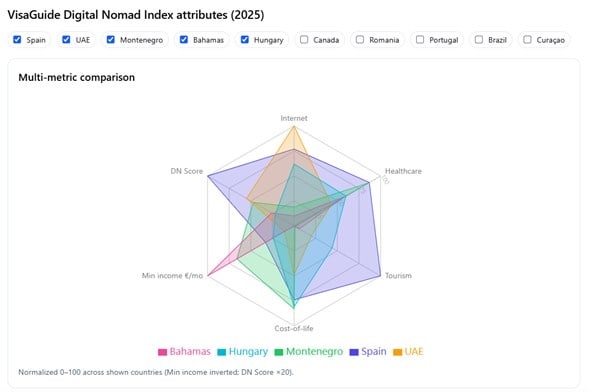
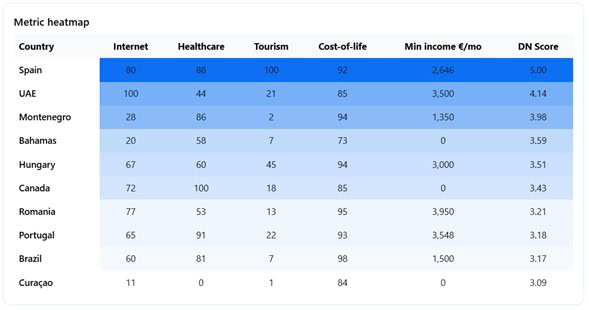
As per VisaGuide, taking all these parameters into consideration, Spain has a perfect 5 Digital Nomad Score, crowning it the top country for digital nomads.
Happiness – lots of it
The World Happiness Report 2025 puts Spain at #38 overall. On the ground, expats rate Spanish cities even higher: Valencia (1st), Málaga (2nd), and Alicante(3rd) take the top three worldwide in 2024 and Madrid and Barcelona also land in the top 10 for expat happiness.
You’ll notice it first in small things: baristas who remember your order, neighbors who wave, afternoons that run a little slower. Give it a week and you’ll catch yourself smiling for no reason. Give it a month and you’ll realize it’s infectious and it’ll change how you work and live.
Nomad Hubs & Communities in Spain
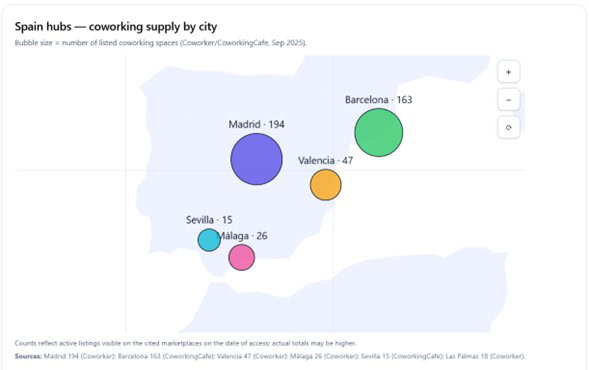
Spain’s popularity for remote work, has caused a surge in co-working communities and international hubs within Spain. And the beauty of it is there is a different city to suit everyone’s taste:
Madrid & Barcelona → best for networking, global events and remote-friendly companies.
Valencia & Malaga → buzzing co-living and co-working with affordable rents.
Canary Islands (Las Palmas & Tenerife) → year-round spring climate and thriving nomad community meetups.
Tarifa → a hidden gem for kitesurfing and work.
Digital Nomad Families
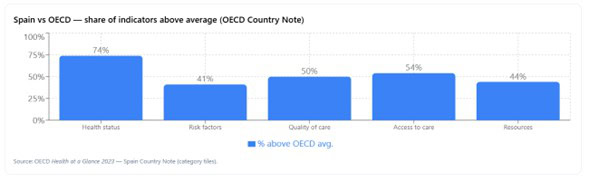
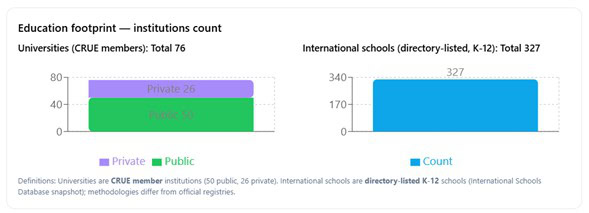
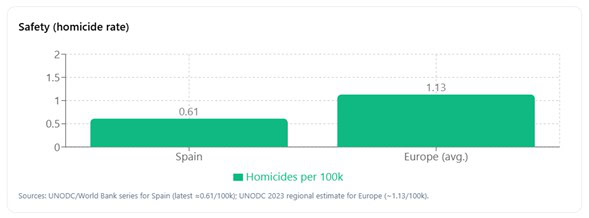
Spain pairs very low violent-crime levels with top-of-EU longevity (84 years), robust healthcare inputs (≥4.5 doctors/1k), solid PISA performance, public schools with bilingual programs and many international schools in all major cities, 1 121university centers and one of Europe’s largest networks of international schools, all key pull factors for international families and remote workers.
So, what is Spain's Digital Nomad Visa?
In Spain, the Digital Nomad Visa (known as international teleworker visa), allows non-EU freelancers and remote employees to live and work in Spain for up to one year (renewable).
Even better: you can bring your family along and if you qualify, also take advantage of the 24% flat tax rate (up to €600k for the first 6 years) under the special regime Beckham Law – a huge perk for remote professionals.
While other countries might offer tax-free periods (partially or during the full visa length), Spain may not win on pure tax savings, it does win on lifestyle and infrastructure and its special tax regime still enables healthcare and public education access.
What You’ll Need to Apply (2025 Requirements)
To be eligible, you have to demonstrate sufficient financial means, have a valid health insurance in Spain with full coverage, clean criminal record and proof of work:
Who can apply?
Non-EU nationals.
Employees with a foreign contract that permits remote work, or
Freelancers with active foreign clients (up to 20% of revenue may come from Spanish clients)
Work criteria
Employees: must have a valid job contract with a foreign employer allowing remote work.
Freelancers: must prove active clients/contract abroad, with no more than 20% of revenue from Spanish companies.
Income rule (2025)
Main applicant: €2 763/month (≈200% SMI).
Spouse/partner: €1 036/month (≈75% SMI).
Each dependent: €345/month (≈25% SMI)
Thresholds are indexed to Spain’s SMI, so confirm the latest figures before applying.
Insurance & Background
Private health insurance authorized to operate in Spain or proof of Spanish Social Security registration.
Clean criminal record covering the last five years
Most non-Spanish documents must be legalized (Apostille) and officially translated into Spanish.
How to Apply for the Digital Nomad Visa
here are two ways for applying to the Spanish DNV:
Applying from outside Spain (visa route)
Submit your DNV visa application at the Spanish consulate in the country where you reside
After approval and entry, apply for your residency card (TIE) in Spain
Applying within Spain (residence route)
If you are already in Spain and meet the criteria, you may apply directly for the residence permit at the local immigration office.
Costs and processing times
If applying from abroad, the visa would typically cost between 80 to 100 euros.
There will be two main tax fees to be paid as part of the process: the National Foreign identification number and the residency card.
This residency route allows you to switch to a Non-Lucrative Visa, Job Seeker Visa, Work Visa and others.
The cherry-on-top? The digital nomad visa can be the first step toward long-term residency.
After 5 years of legal stay in Spain, you may qualify for permanent residency and depending on your citizenship, makes you eligible for the Spanish citizenship.
Before you jump on it
Start with your week, not your wishlist. If your work week runs on client calls across time zones, you want frictionless connectivity and quick access to meeting‑dense cities (Madrid/Barcelona). If your flow depends on long, quiet mornings, then smaller coastal hubs may beat the capital.
Walk the last mile. Book accommodation within a 10–15 minute walk of a coworking you actually like. A good chair and a stable line are productivity multipliers.
Map your non‑work life. Gyms, parks, language schools, kid logistics and your Sunday run matter more after month two than any skyline photo.
Most importantly, before making the big move, spend some time in the city you choose, test the water and learn more about what is great but also what is not so great for your lifestyle. Once you’re ready, go all-in.
A plan
Spain is #1 on multiple digital‑nomad league tables in 2025 for a reason, but lists don’t capture the feel of a week that works: the quiet broadband, the train that connects you to wherever, the sun in February, the school that answers your email, the community vibes. If you want a life that scales beyond a single year abroad, Spain has the parts.
Your next 30 days
Assemble your document pack (police check, apostille, insurance, proof of income, contracts). Digitize everything.
Decide your route (consulate vs. in‑Spain) and book the first appointment you can realistically hit.
Shortlist two cities and book month‑long stays. Visit a coworking the day you arrive. If it’s not a fit, change it.
You don’t have to optimize every variable to start. You need a working week, a path to renew, and a place that keeps you going outside. Spain has all three.
About the author
After spending years in Spain and thousands of euros on lawyers, tax advisors and residency applications, only to realize that doing it yourself is often easier, cheaper, and just as effective. Gerard is an expat on a mission to help others avoid the same costly mistakes. By creating [LiveLoveSpain](https://livelovespain.com), Gerard aims to share first-hand experiences, practical tips, and plenty of “Why didn’t anyone tell me this?!” moments. Whether it’s filing taxes, understanding visas or just mastering the art of Spanish living, he’s here to help fellow expats integrate seamlessly without breaking the bank.
Andrew Williams is the Founder of Remote Tribelife, an online magazine for digital nomads and remote working. Andrew has an extensive background in SEO and content marketing. His experience with digital marketing goes back to his early age in University when he founded a blog about startups and funding. He does his best writing in the coffee shops in Bali or in the condos of busy cities like Bangkok and Singapore. He is currently based in Singapore. You can connect with Andrew on his Linkedin profile and/or follow Remote Tribelife on Instagram.