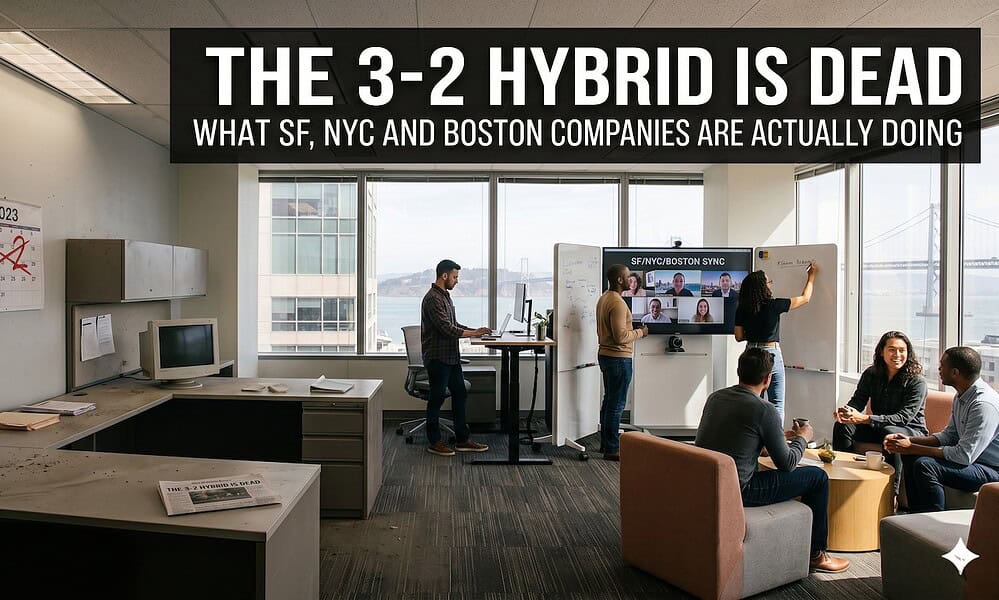



The three-days-in, two-days-remote arrangement was never a strategy. It was a settlement. Companies wanted people back; employees wanted to keep working the way they had. The 3-2 schedule was the number that made the conversation stop, not the one that reflected how either side actually wanted to work.
By 2026, most companies have stopped pretending otherwise. The 3-2 middle ground has largely emptied out, and what’s replaced it is something cleaner, if less comfortable to talk about: a genuine split between companies that are office-committed and companies that are distributed. The ambiguous middle is mostly gone.
For anyone trying to understand where things actually stand in the three cities that define a lot of how the tech and finance industries think about work, here is what the data and the behavior show.
Why the compromise failed
The 3-2 arrangement broke for the same reason most compromises break: it required both sides to permanently accept something they hadn’t agreed to.
For companies that genuinely needed in-person culture (fast-moving startups, trading floors, research labs), three days was not enough to build the dense interaction patterns that make small teams effective. For employees who had restructured their lives around remote work, two days wasn’t enough to justify the trade-offs. Each group kept waiting for the other to acknowledge that the arrangement wasn’t working.
What ended the standoff wasn’t a change in philosophy. It was a change in leverage. By 2025, the job market had tightened enough that mandates became easier to enforce. Amazon called 350,000 employees back to full-time in January 2025. JPMorgan ended remote work for its workforce in April 2025. Instagram moved to five days a week in February 2026. These weren’t cultural statements; they were decisions made by organizations that had decided the productivity and coordination costs of distributed work outweighed the retention risk of demanding otherwise.
On the other side, companies that had already built distributed infrastructure, with documentation-first cultures, async tooling, and hiring practices that didn’t assume geography, quietly dropped any pretense of an office requirement. They didn’t announce it. They just stopped asking.
Subscribe to our Newsletter
Get The Latest News On Digital Nomad Lifestyle, Remote Working Communities
And Much More.
100% spam free. We never share your email address. Unsubscribe anytime!
What San Francisco companies are actually doing
San Francisco is the most polarized of the three cities, and understanding why requires separating two very different parts of its tech ecosystem.
Early-stage startups, particularly the YC-backed companies that form the backbone of SF’s startup culture, have moved harder toward full in-person than almost any other category of employer. The reasoning is practical and consistent: when you’re a team of 12 moving fast on a hard problem, every day without overlap is a day of slow decisions and missed connections. Founders who watched distributed teams drift during the early 2020s have largely concluded that the coordination overhead is not worth it before product-market fit. Many of these companies are now explicitly five-day-a-week operations, and the office space they lease reflects that: private offices with room for the whole team, not drop-in desks.
This map on Tandem Space offers a clear view of this cohort: gives a useful view into this cohort: the companies actively looking for office space in San Francisco skew heavily toward recently funded, headcount-growing teams that have made in-person a deliberate choice rather than a default.
The picture is different for larger SF tech companies. Several major employers have settled into genuine hybrid arrangements at 3-4 days, and a meaningful number of SF-headquartered companies have effectively become distributed-first without changing their official address. The city’s office vacancy rate tells this story indirectly: absorption has improved from its 2024 lows, but overall occupancy has not returned to pre-pandemic levels. Companies are signing leases; they’re not filling them the same way they used to.
If you want to become a digital nomad or find your crew, sign up for our free newsletter and get upcoming articles straight to your inbox!
We’ve got some great content on our Instagram and on our Facebook Group too where you can network with other nomads from all over the world.
What NYC companies are actually doing
New York’s split follows industry lines more than company size.
Finance went back. JPMorgan, Goldman Sachs, and most of the large institutional employers in FiDi have enforced full or near-full in-person attendance. The reasoning in financial services has always been structural: regulation, client relationships, and the way deals and trades get done all favor physical presence in a way that software work does not. That logic didn’t change during the pandemic; it was temporarily overridden.
Tech in New York is more mixed. Larger tech employers have landed at 3-4 day hybrid arrangements with varying levels of enforcement. Startups show the same pattern as SF, where early-stage companies have gone more in-person and growth-stage companies with established remote cultures have largely stayed distributed.
What’s notable in New York is how little the ambiguity that defined 2022-2024 remains. Most major employers have made a call and communicated it. Job postings increasingly specify expectations clearly. The percentage of fully remote job postings across sectors has dropped to roughly 4% of new listings in Q1 2026, while fully on-site roles now account for 77%. The 3-2 ambiguity hasn’t survived into how companies are actually advertising themselves to candidates.
What Boston companies are actually doing
Boston’s story is the least dramatic of the three, which is largely because a significant part of its economy never had a remote-work debate in the first place.
Life sciences and biotech, which anchor Boston’s employment base in Cambridge and the Longwood corridor, are fundamentally in-person industries. Lab work requires physical presence, and the collaborative pattern between researchers and between companies in a district like Kendall Square depends on proximity in ways that video calls don’t replicate. These employers have maintained high in-office expectations throughout.
The software, fintech, and healthcare technology companies concentrated in the Seaport and Downtown show more variation. Several mid-size companies that were genuinely distributed during the pandemic have maintained those arrangements, particularly where they hired broadly across the country during 2020-2022 and built teams that no longer have a geographic center. Others have leaned into return-to-office policies consistent with what New York tech is doing.
The net result is a Boston market where the in-person/remote split largely tracks industry rather than company philosophy.
What actually replaced the 3-2
The clearest way to describe where things stand in May 2026 is that the question has changed. It’s no longer “how many days.” It’s “which camp is this company in.”
Office-committed companies, particularly early-stage startups in all three cities, have made physical presence a deliberate organizational choice. They’ve leased real offices, hired locally, and built culture around being in the same room. For candidates who prefer remote, these companies are identifiable and avoidable. They’re not hiding it.
Genuinely distributed companies have also become more honest about what they are. They hire across geographies, document by default, and don’t maintain office space as a performance of normalcy.
The companies still claiming 3-2 hybrid in 2026 tend to fall into one of two groups: large enterprises mid-transition toward stricter mandates, or smaller organizations that haven’t resolved the internal disagreement yet. Both categories are shrinking.
For anyone who works best remotely, this is actually a more navigable landscape than it was two years ago. Companies have made decisions. The ones that want you in the office will tell you, usually in the job description. The ones that have built seriously distributed cultures are increasingly visible and deliberate about it. The murky middle, where you accepted a role and discovered six months later that “flexible hybrid” meant something different to your manager than it did to you, is harder to fall into now than it was.
The 3-2 compromise wasn’t killed by remote work winning or losing. It was killed by everyone finally getting tired of arguing about it.
Your Travel Resources Handy In One Place 🗺️
🧳 Travel Insurance
Enjoy peace of mind during traveling and don’t leave your country without good travel insurance. We recommend Insured Nomads or Genki for international travel insurance.
💰Travel Finances
Get your travel finances smart and straight with Wise or Revolut.
🏨 Accommodations
For a short stay check out Booking or Agoda. Staying longer? Take a look at the offers at Airbnb. Hostels are the cheapest option that you can explore at Hostelworld.
🏡 Recommended places for long-term stay
Wanna know the accommodations where we lived during our digital nomad journey? Check out the places we enjoyed the most!
🎫 Book tours
Are you up for taking part in epic guided tours? Book ones you like using GetYourGuide or Viator.
🚗 Rent a car
To find great rental car deals check out Rental Cars and get ready for your car trip!
✈️ Book a flight
For the hottest deals check out Skyscanner, Kayak, Google Flights or WayAway.
🛡️ VPN
To stay safely connected while traveling, don’t forget about a good VPN. We recommend Surfshark or NordVPN.
Andrew Williams is the Founder of Remote Tribelife, an online magazine for digital nomads and remote working. Andrew has an extensive background in SEO and content marketing. His experience with digital marketing goes back to his early age in University when he founded a blog about startups and funding. He does his best writing in the coffee shops in Bali or in the condos of busy cities like Bangkok and Singapore. He is currently based in Singapore. You can connect with Andrew on his Linkedin profile and/or follow Remote Tribelife on Instagram.
No Comment! Be the first one.