I live in Taghazout, a fishing village on Morocco’s Atlantic coast about an hour north of Agadir airport, and it has quietly become a winter base for remote workers. Before I moved here I looked for an honest account of what a month on this coast costs and what working from it is really like, and I could not find one. So this is the piece I wanted to read: what a month costs, how well you can work, which month to pick, how you get in, how to fit the surf around a working day — Imsouane included — and what nobody mentions until you have arrived.
Taghazout itself is small — a port about 20 km north of Agadir, as Wikivoyage’s guide describes it — and most of what makes it work for a long stay sits within walking distance: the surf, somewhere to work, cafés and guesthouses.
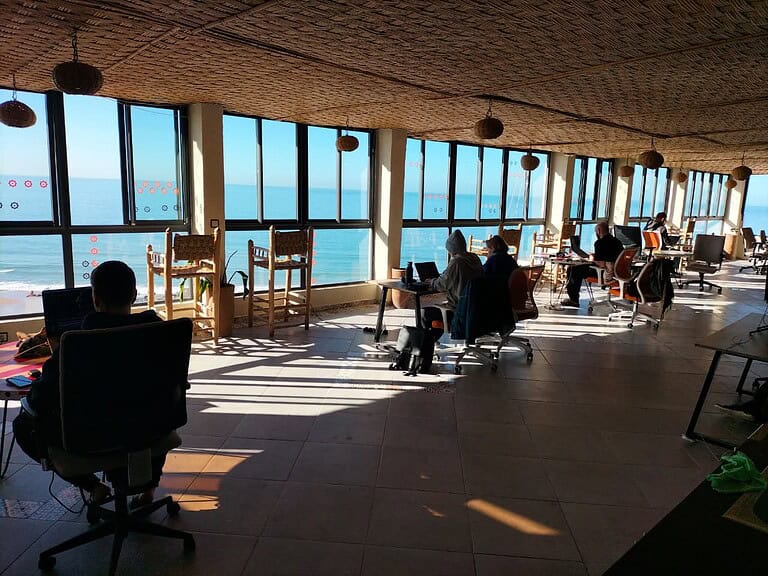
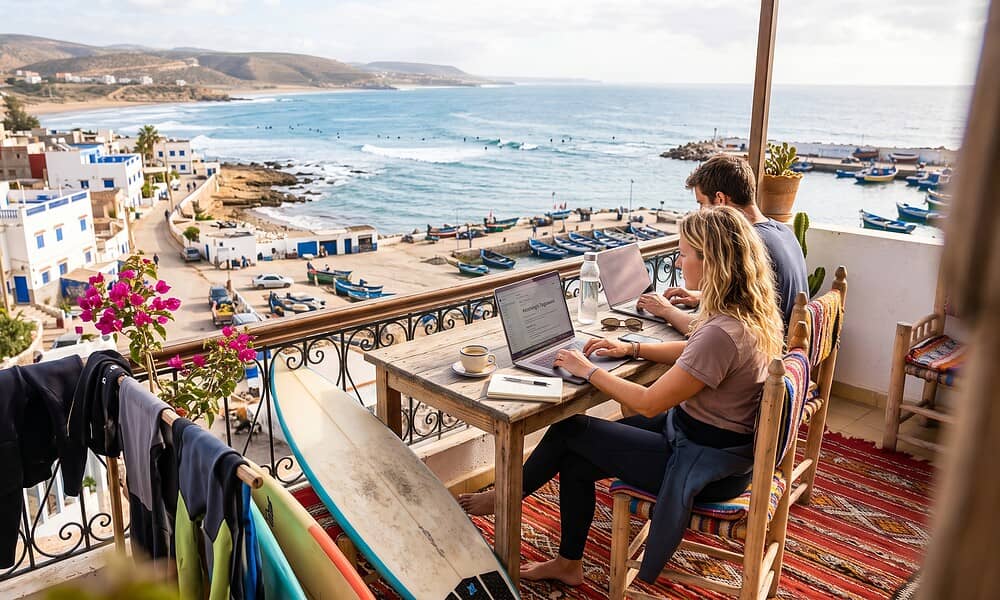
Working with the Atlantic in view. Photo: Taghazout In & Out
At a glance
Airport
Agadir Al Massira (AGA), 45–65 minutes by road
Time zone
UTC+1; UTC+0 during Ramadan (expected 7 Feb – 14 Mar 2027)
Winter air
21–24°C by day, 8–13°C at night
Sea and wetsuit
17–20°C; a 3/2 full suit all winter
Midwinter daylight
About 10h11 (London 7h49)
Busiest weeks
20 December – 7 January
Money
Moroccan dirhams; carry cash, as village ATMs are unreliable at weekends
Imsouane
About 85 minutes north of Taghazout by road
Without a visa
Up to 90 days for British visitors
Co-work and stay
From €351 a week, €879 for 30+ nights (winter 2026/27)
What a month actually costs
Accommodation is most of the budget, and it is where prices vary the most, so I will start with the numbers I can stand behind.
I should be upfront: I run taghazout.io, and I put together co-work-and-stay trips with partners in the village that I have checked in person. At the time of writing, for winter 2026/27, a week of seven nights starts at €351 and a month of 30 nights or more starts at €879. That covers a desk in a coworking space, a bed in a shared dorm, breakfast, one surf session and one yoga session a week, and a one-way airport transfer. A private room adds €27 a night; a private room with an ocean view adds €49.
Timing changes the bill. Package stays that start between 20 December and 7 January are charged at a holiday rate, while one that starts before the 20th keeps the standard rate even if it runs into Christmas. That makes the first half of December arguably the best value of the whole winter: quiet, still at standard prices and already delivering proper winter swell. A stay starting around 8 to 15 December is the sweet spot.
What the package does not cover is where budgets drift: lunch and dinner, extra surf sessions or board hire, a SIM card and getting around. As a rough guide, at roughly 11 dirhams to the euro, breakfast in the village costs 40–60 dirhams, a fish tagine 70–110 and a smoothie 25–35; board hire runs 100–200 dirhams a day, plus around 50–80 for a wetsuit. Where you eat matters more than people expect — beachfront restaurants in Taghazout charge roughly double what the village places do for a similar plate — and Tamraght, 10 to 15 minutes south, is cheaper again: roughly 15 to 25 per cent less for the same standard of room, and a similar margin on food.
The things people forget to budget for: a wetsuit, because the sea sits at 17–20°C all winter; board repairs; laundry; and taxi fares into Agadir. Cash still runs the village — there are ATMs, but they are unreliable at weekends, so bring notes up from Agadir. Everyday things such as sun cream, wax and basic medicines are easy to find in Agadir and, with less choice and at higher prices, in Taghazout. Specific wetsuit sizes and board hardware are the things you cannot count on, so bring what you rely on.
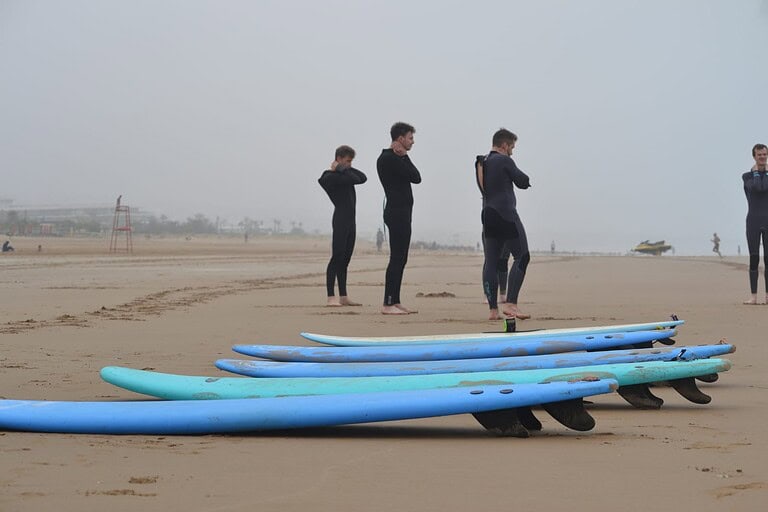
Warming up before a surf lesson. Photo: Taghazout In & Out
Taghazout, Tamraght or Agadir?
If you want to walk to the waves, stay in Taghazout itself. Tamraght, 10 to 15 minutes south, is cheaper, with calmer logistics and the gentler spots close by — Banana Point and the Aourir belt often make a better learning week than a checklist of famous points. Agadir is the practical base: airport access, shops and easier late-night logistics. Its seafront costs more than the village, though, and you trade walking to the surf for a daily drive.
Connectivity, honestly
If your work runs on video calls, plan them around a coworking desk rather than your room. A coworking space is built for exactly that: proper desks and chairs and a connection shared by people who also need it to work. Most guesthouses and hostels have Wi-Fi too, as Wikivoyage notes, but a shared-house connection is the one to test before you rely on it for a client call.
Get a local SIM with mobile data as soon as you land — SIM cards are easiest to find in Agadir and available in the village for a little more — and treat it as your backup hotspot. Connections and power can drop anywhere, and the habits that save a working day here are the same as everywhere: Keep a power bank charged, keep the hotspot ready, and do not put your most important call on your first morning, before you have tested your setup.
The winter case
November to March is the draw. Daytime highs in Agadir run from about 21°C in January to 24°C in November, on NOAA’s 1981–2010 averages as summarised on Wikipedia’s Agadir page. The nights are cooler than people expect, roughly 8°C to 13°C, so pack something warm for the evenings. The sea stays between 17°C and 20°C through the winter: a 3/2 full suit covers it, and some surfers add boots for long point sessions in January.
The bigger difference is light. On the shortest day of the year this coast gets about 10 hours 11 minutes of daylight; London gets 7 hours 49 and Berlin 7 hours 39. That is two and a half more hours of daylight a day, and it changes what a working day feels like.
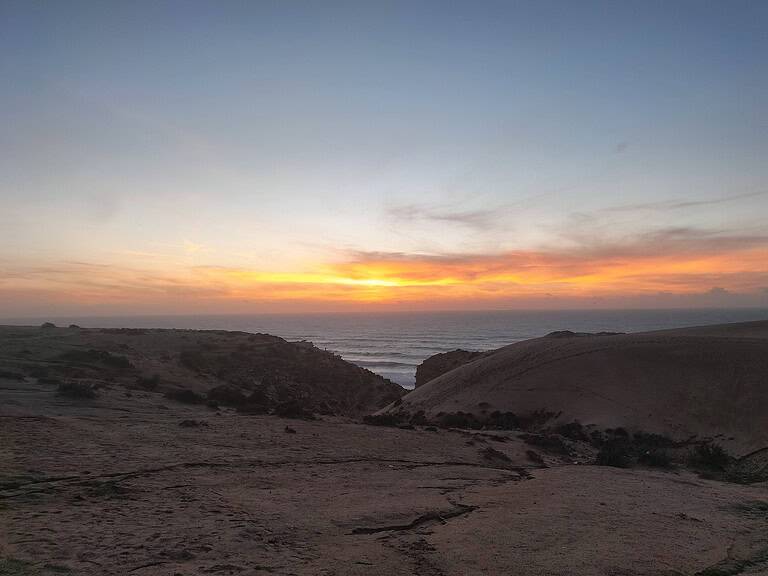
A February sunset on the coast. Photo: Taghazout In & Out
Which month to come
November is when the coast changes character: the first sustained north-west groundswell arrives, the points start running for days at a time, and the water is still near 20°C. It fills fast, and the accommodation nearest the points usually goes two to three months ahead. December splits in two: quiet and good value up to about the 18th, then busy and pricier from the 20th into early January. January is the deepest swell month, when the right-hand points can run for several days in a row.
February brings the coldest water of the year, typically 17°C, and more mixed wind, so morning sessions matter more. Inland the almond trees flower, which makes Paradise Valley and the Anti-Atlas roads a good option for a flat day, when there are no waves; UK and French half-term brings a short crowd spike in the middle of the month. March is the last month you can plan around the points: days pass 12 hours of light and the afternoons get genuinely warm, but the spring northerly starts to build, so the clean window narrows to the first half of the day.
In the heart of the winter, expect busy line-ups at the best-known points and quiet beaches. In January the village is full of surfers, not sunbathers.
Working hours and the clock
For most of the winter Morocco runs on UTC+1 — the same clock as Paris, Berlin, Amsterdam and Warsaw, and one hour ahead of London. During Ramadan the country moves back an hour to UTC+0. In 2027 that is expected to run from about 7 February to 14 March, and Morocco confirms the exact dates shortly beforehand. If your team is on central European time, your calls shift by an hour for those five weeks, so it is worth knowing before you book.
Ramadan changes the daily rhythm more than the logistics. Surf schools, transfers and most guesthouses run normally, but some village cafés and restaurants close during daylight or open late, and evenings get busier after sunset, so plan lunch around where you are staying.
Getting in
The airport is Agadir Al Massira (AGA). From touchdown to the coast is roughly 45 to 65 minutes by road. Wikivoyage puts a taxi from the airport at around 300 dirhams, and a private airport run usually costs 300 to 400. Once you are here, a seat in a shared grand taxi between Taghazout and Agadir costs 20 to 30 dirhams, and Wikivoyage also lists local buses 32 and 33 from Agadir’s Souk El Had to Taghazout for about 7 dirhams.
Direct flights are the easy part. Ryanair, easyJet, Wizz Air and Transavia fly to Agadir from much of Europe, with Jet2, TUI, Royal Air Maroc and Air Arabia Maroc on some routes. I keep route data for 52 European cities into Agadir, and most of the seasonal routes run through the winter months, roughly October to April.
This winter adds more. Ryanair’s Morocco winter programme is its biggest yet — 5.3 million seats, 156 destinations and 17 new routes, according to North Africa Post — and it includes new Agadir services from Milan, Nuremberg, Bratislava and Gdańsk. Aviation Week reports that the Milan Malpensa route goes head to head with Wizz Air.
On paperwork: British visitors can stay up to 90 days without a visa, and their passport must be valid for at least three months after arrival, according to the UK Foreign Office. If you travel on another passport, check your own government’s advice.
Surfing around a work schedule
This is the real reason most people stay. The coast between Imsouane and Agadir runs from forgiving beach breaks to some of Morocco’s best-known points, and the whole game is matching the spot to the hour you have.
With an hour before work, stay close and keep it simple. In the village, the bay and Hash Point are walkable progression waves, and Panorama, just south, is a soft point. Around Tamraght and Aourir, Banana Point, Devil’s Rock, Cro-Cro and Tamraght beach are beginner-to-progression spots too, and so is Anza on the Agadir side. With more time and more experience, Anchor Point, La Source, Mysteries, KM11 and KM12 suit intermediate and advanced surfers, while Killer Point, Boilers and Dracula’s are for advanced surfers only. Tamri, an exposed beach break about 48 minutes north, is for intermediate and advanced surfers too.
The rhythm that works is to surf around the edges of the day. The mornings are often the cleanest window, before the wind picks up, which suits an early session before a 10am start; the late-afternoon light is the other slot. Check the forecast the night before, pick the spot that fits the hour you have, and save the long drives for the weekend.
What makes it workable is knowing which spot is on before you leave the desk. I built a free forecast for 20 of these spots, Imsouane included, that scores each one against its own ideal swell and wind rather than giving one generic rating, so you can see at a glance whether the wave you can reach before a 10am call is actually working.
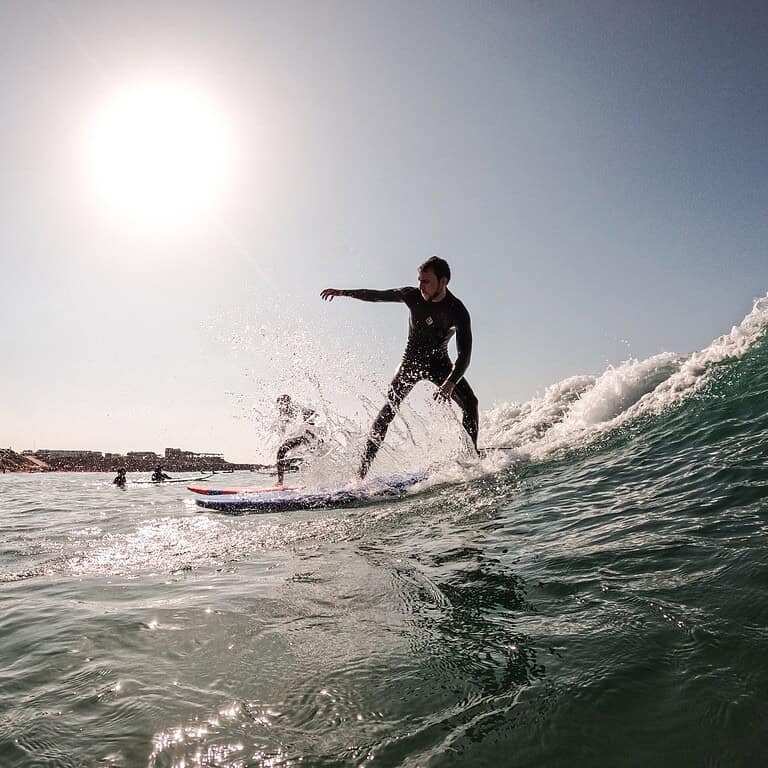
A November session. Photo: Taghazout In & Out
Imsouane: the long weekend
About 85 minutes north of Taghazout by road, Imsouane is worth a weekend of its own. Its bay is a long, mellow right-hander for beginners and improving surfers, while the Cathedral is the more powerful side of Imsouane — a point and reef for capable surfers. If you are travelling as a mixed group, compare the two before you choose where to paddle out.
Treat it as a planned trip rather than a quick hop: you need a car or a transfer, especially with boards, and it is worth staying a night or two so you can surf it when the conditions line up rather than whenever you happen to arrive. It is also the escape valve over Christmas and New Year: when the village points are at their busiest, Imsouane and Tamri are where to go. Both Imsouane spots are in the forecast, so you can pick the weekend that works.
The trade-offs I wish someone had told me
Taghazout is a small village, and within a few weeks you will know most of it. For a lot of people that is the appeal; for some it is the problem.
It is also a conservative place. Dress and behave as you would in any small Moroccan town — cover up away from the beach, and ask before you photograph people. Alcohol is limited, and the village is not a place for bars and big nights out, so if that matters to you, know it before you come.
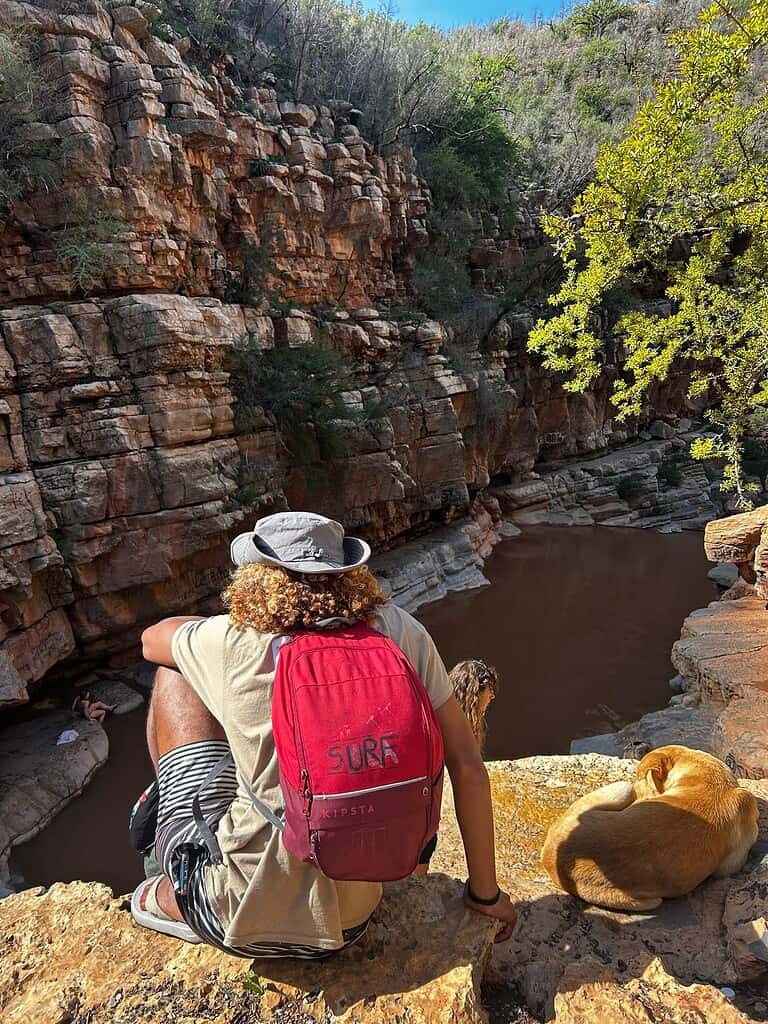
And if you need a buzzing scene, you will probably be bored by week three. The people who love a winter here want the opposite: an early session, a focused working day and a quiet evening. If the village starts to feel small, a day off inland changes the scenery completely — Paradise Valley, the Timlalin dunes and Agadir’s medina all make a good day out.
Is it worth it?
If what you want from a winter is daylight, a sea that is at its best in exactly these months, and a working day that fits around both, this coast is hard to beat. Come for a week before you commit to a month — the village is small enough that you will know within a few days whether it is your place.
About the author
Taghazout In & Out runs taghazout.io, a free live surf forecast for 20 spots on Morocco’s Atlantic coast in 10 languages, and helps travellers and remote workers plan a trip on this coast.









No Comment! Be the first one.